9–61. Trigonometric integrals Evaluate the following integrals. 45. ∫ sec²x tan¹ᐟ²x dx
Verified step by step guidance
1
Step 1: Recognize the integral involves trigonometric functions sec²x and tan¹ᐟ²x. Recall that sec²x is the derivative of tan(x), which suggests a substitution method might be useful.
Step 2: Let u = tan(x). Then, du = sec²x dx. This substitution simplifies the integral by replacing sec²x dx with du and tan¹ᐟ²x with u¹ᐟ².
Step 3: Rewrite the integral in terms of u: ∫ sec²x tan¹ᐟ²x dx becomes ∫ u¹ᐟ² du.
Step 4: Apply the power rule for integration: ∫ uⁿ du = (uⁿ⁺¹)/(n+1), where n ≠ -1. Here, n = 1/2, so the integral becomes (u³ᐟ²)/(3/2) + C.
Step 5: Substitute back u = tan(x) to express the result in terms of x: (tan³ᐟ²x)/(3/2) + C.
Verified video answer for a similar problem:
This video solution was recommended by our tutors as helpful for the problem above
Video duration:
2m
Play a video:
0 Comments
Key Concepts
Here are the essential concepts you must grasp in order to answer the question correctly.
Trigonometric Functions
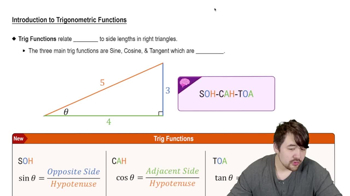
Trigonometric functions, such as secant (sec) and tangent (tan), are fundamental in calculus, representing relationships between angles and sides of triangles. The secant function is the reciprocal of the cosine function, while the tangent function is the ratio of the sine to the cosine. Understanding these functions is crucial for evaluating integrals involving them.
Integration techniques, including substitution and integration by parts, are essential for solving complex integrals. In the case of the integral ∫ sec²x tan¹ᐟ²x dx, recognizing the relationship between the functions can simplify the process. Mastery of these techniques allows for the effective evaluation of integrals that may not be straightforward.
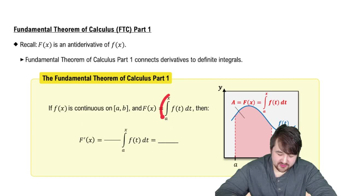
The Fundamental Theorem of Calculus links differentiation and integration, stating that if a function is continuous on an interval, the integral of its derivative over that interval equals the difference in the function's values at the endpoints. This theorem provides a foundation for evaluating definite and indefinite integrals, making it a key concept in understanding the behavior of functions and their integrals.