
Ch. 6 - Applications of Integration
Briggs - Calculus: Early Transcendentals 3rd Edition
Briggs3rd EditionCalculus: Early TranscendentalsISBN: 9780136847243Not the one you use?Change textbook
Chapter 6, Problem 6.1.21a

17–22. Position from velocity Consider an object moving along a line with the given velocity v and initial position.


a. Determine the position function, for t≥0, using the antiderivative method


v(t) = 9−t² on [0, 4]; s(0)=−2

Verified step by step guidance
1
Recall that the position function \(s(t)\) is the antiderivative (integral) of the velocity function \(v(t)\) plus the initial position constant. Mathematically, this is expressed as \(s(t) = \int v(t) \, dt + C\).
Given the velocity function \(v(t) = 9 - t^{2}\), set up the integral to find the position function: \(s(t) = \int (9 - t^{2}) \, dt + C\).
Integrate each term separately: the integral of 9 with respect to \(t\) is \$9t\(, and the integral of \)-t^{2}\( with respect to \)t$ is \(-\frac{t^{3}}{3}\). So, \(s(t) = 9t - \frac{t^{3}}{3} + C\).
Use the initial condition \(s(0) = -2\) to solve for the constant \(C\). Substitute \(t=0\) into the position function: \(s(0) = 9 \cdot 0 - \frac{0^{3}}{3} + C = C\). Since \(s(0) = -2\), it follows that \(C = -2\).
Write the final position function incorporating the constant: \(s(t) = 9t - \frac{t^{3}}{3} - 2\) for \(t \geq 0\).

Verified video answer for a similar problem:

This video solution was recommended by our tutors as helpful for the problem above.
Video duration:
2m
Was this helpful?

Key Concepts

Here are the essential concepts you must grasp in order to answer the question correctly.

Velocity and Position Relationship

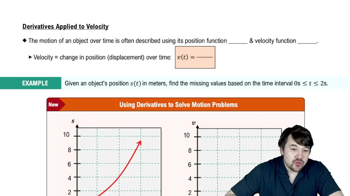
Velocity is the rate of change of position with respect to time. The position function s(t) describes the location of an object at time t, and its derivative s'(t) equals the velocity v(t). Understanding this relationship allows us to find position by integrating velocity.
Recommended video:
06:29
Derivatives Applied To Velocity

Antiderivative (Indefinite Integral)

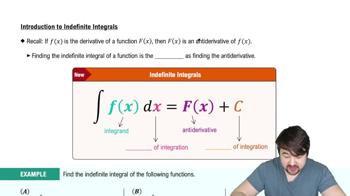
The antiderivative of a function is another function whose derivative is the original function. To find position from velocity, we compute the antiderivative of v(t), which gives s(t) plus a constant of integration. This constant is determined using initial conditions.
Recommended video:
05:04
Introduction to Indefinite Integrals

Initial Conditions and Constants of Integration

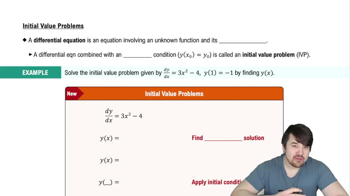
When integrating velocity to find position, an unknown constant appears. The initial condition, such as s(0) = -2, allows us to solve for this constant, ensuring the position function accurately reflects the object's starting location.
Recommended video:
05:03
Initial Value Problems
Related Practice
Textbook Question

Calculating work for different springs Calculate the work required to stretch the following springs 0.5m from their equilibrium positions. Assume Hooke’s law is obeyed.

a. A spring that requires a force of 50 N to be stretched 0.2 m from its equilibrium position

52
views
Textbook Question

In the design of solid objects (both artificial and natural), the ratio of the surface area to the volume of the object is important. Animals typically generate heat at a rate proportional to their volume and lose heat at a rate proportional to their surface area. Therefore, animals with a low SAV ratio tend to retain heat, whereas animals with a high SAV ratio (such as children and hummingbirds) lose heat relatively quickly.


a. What is the SAV ratio of a cube with side lengths a?

55
views
Textbook Question

Critical depth A large tank has a plastic window on one wall that is designed to withstand a force of 90,000 N. The square window is 2 m on a side, and its lower edge is 1 m from the bottom of the tank.

a. If the tank is filled to a depth of 4 m, will the window withstand the resulting force?

56
views
Textbook Question

"Determine whether the following statements are true and give an explanation or counterexample.


a. A pyramid is a solid of revolution. "

71
views
Textbook Question

Mass of two bars Two bars of length L have densities ρ₁(x) = 4e^−x and ρ₂(x) = 6e^−2x, for 0≤x≤L.

a. For what values of L is bar 1 heavier than bar 2?

36
views
Textbook Question

9–10. Velocity graphs The figures show velocity functions for motion along a line. Assume the motion begins with an initial position of s(0)=0. Determine the following.

a. The displacement between t=0 and t=5

71
views