Find y'' for the following functions. y = ex sin x
Verified step by step guidance
1
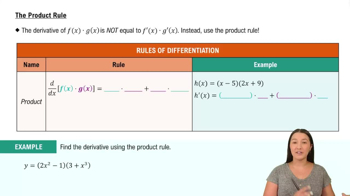
First, identify the function y = e^x * sin(x). This is a product of two functions, so we will use the product rule for differentiation.
Apply the product rule: If y = u * v, then y' = u' * v + u * v'. Here, let u = e^x and v = sin(x).
Differentiate u = e^x to get u' = e^x. Differentiate v = sin(x) to get v' = cos(x).
Substitute these derivatives into the product rule formula: y' = e^x * sin(x) + e^x * cos(x).
Differentiate y' again to find y''. Use the product rule on each term separately: For the first term, differentiate e^x * sin(x) again, and for the second term, differentiate e^x * cos(x). Combine these results to find y''.
Verified video answer for a similar problem:
This video solution was recommended by our tutors as helpful for the problem above
Video duration:
5m
Play a video:
Was this helpful?
Key Concepts
Here are the essential concepts you must grasp in order to answer the question correctly.
Higher-Order Derivatives
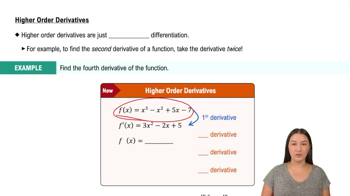
Higher-order derivatives refer to the derivatives of a function beyond the first derivative. The second derivative, denoted as y'', measures the rate of change of the first derivative, providing insights into the function's concavity and acceleration. Understanding how to compute higher-order derivatives is essential for analyzing the behavior of functions in calculus.
The product rule is a fundamental differentiation technique used when finding the derivative of the product of two functions. It states that if u(x) and v(x) are functions, then the derivative of their product is given by u'v + uv'. This rule is particularly important when differentiating functions like y = e^x sin x, which is a product of two distinct functions.
The chain rule is a method for differentiating composite functions. It states that if a function y is composed of another function u, then the derivative of y with respect to x is the derivative of y with respect to u multiplied by the derivative of u with respect to x. This rule is crucial when dealing with functions that involve exponentials and trigonometric functions, as seen in y = e^x sin x.