
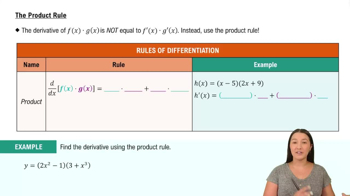
First, identify that the function y = x sin(x) is a product of two functions: u(x) = x and v(x) = sin(x). To find the first derivative y', use the product rule: (uv)' = u'v + uv'.
Calculate the derivative of u(x) = x, which is u'(x) = 1.
Calculate the derivative of v(x) = sin(x), which is v'(x) = cos(x).
Apply the product rule: y' = u'v + uv' = (1)(sin(x)) + (x)(cos(x)) = sin(x) + x cos(x).
To find the second derivative y'', differentiate y' = sin(x) + x cos(x) with respect to x. Use the sum rule and the product rule again for the term x cos(x). The derivative of sin(x) is cos(x), and for x cos(x), apply the product rule: (x cos(x))' = (1)(cos(x)) + (x)(-sin(x)) = cos(x) - x sin(x). Therefore, y'' = cos(x) + (cos(x) - x sin(x)).
Verified video answer for a similar problem:
This video solution was recommended by our tutors as helpful for the problem above
Video duration:
7m
Play a video:
Was this helpful?
Key Concepts
Here are the essential concepts you must grasp in order to answer the question correctly.
Differentiation
Differentiation is the process of finding the derivative of a function, which represents the rate of change of the function with respect to its variable. In this context, we need to differentiate the function y = x sin x to find its first derivative, y', and then differentiate y' to find the second derivative, y''. This process is fundamental in calculus for analyzing the behavior of functions.
The Product Rule is a formula used to differentiate products of two functions. It states that if you have two functions u(x) and v(x), the derivative of their product is given by u'v + uv'. In the case of y = x sin x, we will apply the Product Rule to differentiate the function correctly, ensuring we account for both components of the product.
The second derivative of a function, denoted as y'', is the derivative of the first derivative, y'. It provides information about the curvature of the function and can indicate points of inflection. In this problem, finding y'' will help us understand how the rate of change of y = x sin x evolves, which is crucial for analyzing its behavior in applications such as motion or optimization.