Does the accuracy of an approximation given by a Taylor polynomial generally increase or decrease with the order of the approximation? Explain.
Table of contents
- 0. Functions7h 54m
- Introduction to Functions16m
- Piecewise Functions10m
- Properties of Functions9m
- Common Functions1h 8m
- Transformations5m
- Combining Functions27m
- Exponent rules32m
- Exponential Functions28m
- Logarithmic Functions24m
- Properties of Logarithms36m
- Exponential & Logarithmic Equations35m
- Introduction to Trigonometric Functions38m
- Graphs of Trigonometric Functions44m
- Trigonometric Identities47m
- Inverse Trigonometric Functions48m
- 1. Limits and Continuity2h 2m
- 2. Intro to Derivatives1h 33m
- 3. Techniques of Differentiation3h 18m
- 4. Applications of Derivatives2h 38m
- 5. Graphical Applications of Derivatives6h 2m
- 6. Derivatives of Inverse, Exponential, & Logarithmic Functions2h 37m
- 7. Antiderivatives & Indefinite Integrals1h 26m
- 8. Definite Integrals4h 44m
- 9. Graphical Applications of Integrals2h 27m
- 10. Physics Applications of Integrals 3h 16m
- 11. Integrals of Inverse, Exponential, & Logarithmic Functions2h 34m
- 12. Techniques of Integration7h 41m
- 13. Intro to Differential Equations2h 55m
- 14. Sequences & Series5h 36m
- 15. Power Series2h 19m
- 16. Parametric Equations & Polar Coordinates7h 58m
15. Power Series
Taylor Series & Taylor Polynomials
Problem 11.2.67c
Textbook Question
Explain why or why not Determine whether the following statements are true and give an explanation or counterexample.
c. If f has a Taylor series that converges only on (−2,2), then f(x²) has a Taylor series that also converges only on (−2,2).
Verified step by step guidance1
Recall that the radius of convergence of a Taylor series centered at 0 is the distance from 0 to the nearest singularity of the function in the complex plane.
Given that the Taylor series of \( f \) converges only on the interval \( (-2, 2) \), this means the radius of convergence \( R \) of \( f \) is 2.
Now consider the function \( g(x) = f(x^2) \). To find the radius of convergence of the Taylor series of \( g \), analyze how the substitution \( x^2 \) affects the domain.
Since \( g(x) = f(x^2) \), the series for \( g \) converges when \( |x^2| < 2 \), which simplifies to \( |x| < \sqrt{2} \).
Therefore, the radius of convergence of the Taylor series for \( g(x) \) is \( \sqrt{2} \), which is different from the original radius 2, so the statement is false.
Verified video answer for a similar problem:This video solution was recommended by our tutors as helpful for the problem above
Video duration:
2mPlay a video:
Was this helpful?
Key Concepts
Here are the essential concepts you must grasp in order to answer the question correctly.
Radius of Convergence of a Taylor Series
The radius of convergence is the distance from the center point within which a Taylor series converges to the function. It depends on the function's behavior and singularities in the complex plane. Understanding this helps determine where the series representation is valid.
Recommended video:
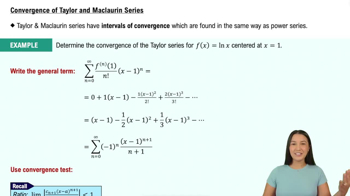
Convergence of Taylor & Maclaurin Series
Composition of Functions and Its Effect on Convergence
When composing functions, such as considering f(x²), the domain and convergence properties can change. The substitution x² affects the input range and may alter the radius of convergence of the resulting Taylor series.
Recommended video:
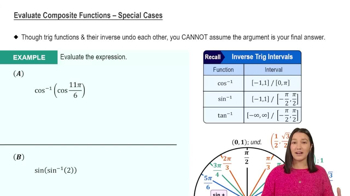
Evaluate Composite Functions - Special Cases
Counterexamples in Analysis
Counterexamples demonstrate that a general statement is false by providing a specific case where it fails. Constructing or identifying counterexamples is crucial to test claims about convergence and function behavior rigorously.
Recommended video:
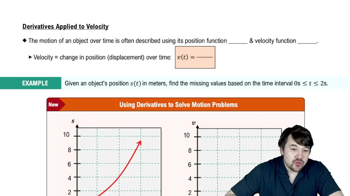
Derivatives Applied To Velocity
Related Videos
Related Practice
Textbook Question
15
views