
Suppose f(0)=1, f'(0)=0, f''(0)=2, and f⁽³⁾(0)=6. Find the third-order Taylor polynomial for f centered at 0 and use it to approximate f(0.2).
Verified step by step guidance
1
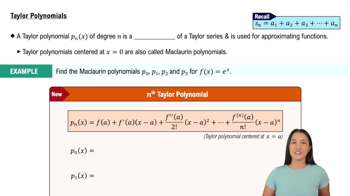
Recall the formula for the third-order Taylor polynomial of a function \( f \) centered at \( a = 0 \):
\[ P_3(x) = f(0) + f'(0) x + \frac{f''(0)}{2!} x^2 + \frac{f^{(3)}(0)}{3!} x^3 \]
Substitute the given values into the polynomial:
\[ f(0) = 1, \quad f'(0) = 0, \quad f''(0) = 2, \quad f^{(3)}(0) = 6 \]
So,
\[ P_3(x) = 1 + 0 \cdot x + \frac{2}{2} x^2 + \frac{6}{6} x^3 \]
Simplify the coefficients in the polynomial:
\[ P_3(x) = 1 + x^2 + x^3 \]
To approximate \( f(0.2) \), substitute \( x = 0.2 \) into the polynomial:
\[ P_3(0.2) = 1 + (0.2)^2 + (0.2)^3 \]
Calculate the powers of \( 0.2 \) (without final summation) to prepare for approximation:
\[ (0.2)^2 = 0.04, \quad (0.2)^3 = 0.008 \]
Then, sum these terms with 1 to get the approximate value of \( f(0.2) \).
Verified video answer for a similar problem:
This video solution was recommended by our tutors as helpful for the problem above
Video duration:
3m
Play a video:
Was this helpful?
Key Concepts
Here are the essential concepts you must grasp in order to answer the question correctly.
Taylor Polynomial
A Taylor polynomial approximates a function near a specific point using derivatives at that point. The nth-order Taylor polynomial includes terms up to the nth derivative, providing a polynomial that closely matches the function's behavior near the center.
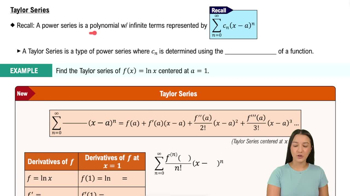
Derivatives at the center point determine the coefficients of the Taylor polynomial. Each term involves the function's nth derivative evaluated at the center, divided by n! and multiplied by (x - center)^n, capturing the function's local rate of change.
Once the Taylor polynomial is constructed, it can be used to approximate function values near the center by substituting the desired x-value. This provides an estimate that becomes more accurate with higher-order polynomials and points closer to the center.