Suppose you use a second-order Taylor polynomial centered at 0 to approximate a function f. What matching conditions are satisfied by the polynomial?
Table of contents
- 0. Functions7h 54m
- Introduction to Functions16m
- Piecewise Functions10m
- Properties of Functions9m
- Common Functions1h 8m
- Transformations5m
- Combining Functions27m
- Exponent rules32m
- Exponential Functions28m
- Logarithmic Functions24m
- Properties of Logarithms36m
- Exponential & Logarithmic Equations35m
- Introduction to Trigonometric Functions38m
- Graphs of Trigonometric Functions44m
- Trigonometric Identities47m
- Inverse Trigonometric Functions48m
- 1. Limits and Continuity2h 2m
- 2. Intro to Derivatives1h 33m
- 3. Techniques of Differentiation3h 18m
- 4. Applications of Derivatives2h 38m
- 5. Graphical Applications of Derivatives6h 2m
- 6. Derivatives of Inverse, Exponential, & Logarithmic Functions2h 37m
- 7. Antiderivatives & Indefinite Integrals1h 26m
- 8. Definite Integrals4h 44m
- 9. Graphical Applications of Integrals2h 27m
- 10. Physics Applications of Integrals 3h 16m
- 11. Integrals of Inverse, Exponential, & Logarithmic Functions2h 34m
- 12. Techniques of Integration7h 41m
- 13. Intro to Differential Equations2h 55m
- 14. Sequences & Series5h 36m
- 15. Power Series2h 19m
- 16. Parametric Equations & Polar Coordinates7h 58m
15. Power Series
Taylor Series & Taylor Polynomials
Problem 11.3.9b
Textbook Question
Taylor series and interval of convergence
a. Use the definition of a Taylor/Maclaurin series to find the first four nonzero terms of the Taylor series for the given function centered at a.
b. Write the power series using summation notation.
f(x) = 1/x², a=1
Verified step by step guidance1
Identify the function and the center of the Taylor series: here, the function is \(f(x) = \frac{1}{x^2}\) and the series is centered at \(a = 1\).
Recall the Taylor series formula centered at \(a\):
\[
T(x) = \sum_{n=0}^{\infty} \frac{f^{(n)}(a)}{n!} (x - a)^n
\]
where \(f^{(n)}(a)\) is the \(n\)th derivative of \(f\) evaluated at \(x = a\).
Calculate the first four derivatives of \(f(x)\):
- \(f(x) = x^{-2}\)
- \(f'(x) = -2x^{-3}\)
- \(f''(x) = 6x^{-4}\)
- \(f^{(3)}(x) = -24x^{-5}\)
Then evaluate each at \(x = 1\).
Write out the first four nonzero terms of the Taylor series using the formula:
\[
T(x) \approx f(1) + f'(1)(x-1) + \frac{f''(1)}{2!}(x-1)^2 + \frac{f^{(3)}(1)}{3!}(x-1)^3
\]
Express the Taylor series in summation notation:
\[
T(x) = \sum_{n=0}^{\infty} \frac{f^{(n)}(1)}{n!} (x - 1)^n
\]
where you can use the pattern found in the derivatives to write a general formula for \(f^{(n)}(1)\) if possible.
Verified video answer for a similar problem:This video solution was recommended by our tutors as helpful for the problem above
Video duration:
4mPlay a video:
Was this helpful?
Key Concepts
Here are the essential concepts you must grasp in order to answer the question correctly.
Taylor and Maclaurin Series Definition
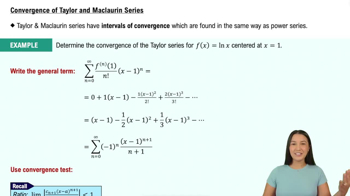
A Taylor series represents a function as an infinite sum of terms calculated from the derivatives of the function at a single point a. The Maclaurin series is a special case centered at a = 0. Each term involves the nth derivative evaluated at a, multiplied by (x - a)^n and divided by n!. This expansion approximates the function near the point a.
Recommended video:
Convergence of Taylor & Maclaurin Series
Power Series and Summation Notation
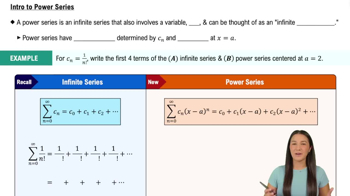
A power series is an infinite series of the form Σ c_n (x - a)^n, where c_n are coefficients and a is the center. Writing a Taylor series in summation notation compactly expresses all terms using an index n, making it easier to analyze and manipulate. Understanding this notation is essential for representing and working with series efficiently.
Recommended video:
Intro to Power Series
Interval of Convergence
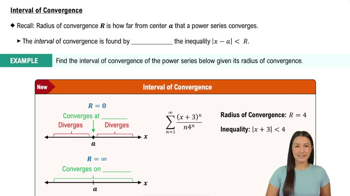
The interval of convergence is the set of x-values for which the Taylor series converges to the function. It depends on the function and the center a. Determining this interval often involves applying convergence tests like the ratio test. Knowing the interval ensures the series accurately represents the function within that range.
Recommended video:
Interval of Convergence
Related Videos
Related Practice
Textbook Question
16
views