
The first three Taylor polynomials for f(x)=√(1+x) centered at 0 are p₀ = 1, p₁ = 1+x/2, and p₂ = 1 + x/2 − x²/8. Find three approximations to √1.1.
Verified step by step guidance
1
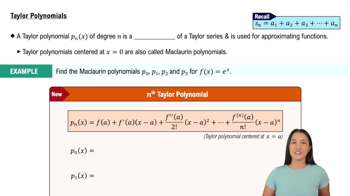
Recall that the Taylor polynomials for \(f(x) = \sqrt{1+x}\) centered at 0 are given as \(p_0 = 1\), \(p_1 = 1 + \frac{x}{2}\), and \(p_2 = 1 + \frac{x}{2} - \frac{x^2}{8}\).
To approximate \(\sqrt{1.1}\), rewrite it as \(f(0.1)\) since \$1.1 = 1 + 0.1$ and the polynomials are centered at 0.
Substitute \(x = 0.1\) into each polynomial to get the approximations: \(p_0(0.1)\), \(p_1(0.1)\), and \(p_2(0.1)\).
Calculate \(p_0(0.1) = 1\) as the simplest approximation.
Calculate \(p_1(0.1) = 1 + \frac{0.1}{2}\) and \(p_2(0.1) = 1 + \frac{0.1}{2} - \frac{(0.1)^2}{8}\) to get more accurate approximations.
Verified video answer for a similar problem:
This video solution was recommended by our tutors as helpful for the problem above
Video duration:
2m
Play a video:
Was this helpful?
Key Concepts
Here are the essential concepts you must grasp in order to answer the question correctly.
Taylor Polynomials
Taylor polynomials approximate a function near a specific point using a finite sum of derivatives at that point. Each polynomial of degree n matches the function's value and its first n derivatives at the center, providing increasingly accurate approximations as n increases.
Approximating a function value at a point involves substituting the point into the Taylor polynomial. Lower-degree polynomials give rough estimates, while higher-degree polynomials improve accuracy by including more terms that capture the function's behavior.
The function f(x) = √(1+x) is smooth near x=0, making it suitable for Taylor expansion. Approximating √1.1 means evaluating the polynomial at x=0.1, which simplifies calculations and provides a close estimate without directly computing the square root.