
Textbook Question
Finding Functions from Derivatives
In Exercises 37–40, find the function with the given derivative whose graph passes through the point P.
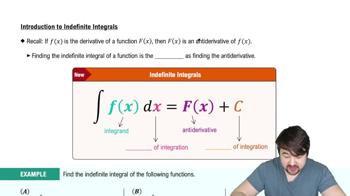
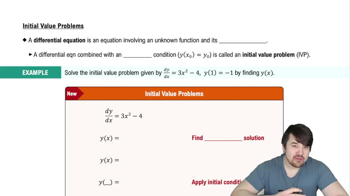
r'(t) = sec t tan t − 1, P(0, 0)
179
views

 Verified step by step guidance
 05:04
05:04
 05:03
05:03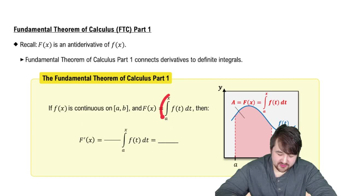 06:11
06:11Finding Functions from Derivatives
In Exercises 37–40, find the function with the given derivative whose graph passes through the point P.
r'(t) = sec t tan t − 1, P(0, 0)
In Exercises 9–66, graph the function using appropriate methods from the graphing procedures presented just before Example 9, identifying the coordinates of any local extreme points and inflection points. Then find coordinates of absolute extreme points, if any.
46. y = cos(x) + √3 * sin(x), 0 ≤ x ≤ 2π
Each of Exercises 43–48 gives the first derivative of a function y = ƒ(𝓍). (a) At what points, if any, does the graph of ƒ have a local maximum, local minimum, or inflection point? (b) Sketch the general shape of the graph.
y' = 𝓍² ― 𝓍―6
Finding Position from Velocity or Acceleration
Exercises 45–48 give the acceleration a=d²s/dt², initial velocity, and initial position of an object moving on a coordinate line. Find the object’s position at time t.
a = 32, v(0) = 20, s(0) = 5
Graphs and Graphing
Graph the curves in Exercises 33–42.
______
y = 𝓍√4 ― 𝓍²
Finding Position from Velocity or Acceleration
Exercises 41–44 give the velocity v = ds/dt and initial position of an object moving along a coordinate line. Find the object’s position at time t.
v = 9.8t + 5, s(0) = 10