Find a formula for each function graphed in Exercises 29–32.
b. <IMAGE>
Verified step by step guidance
1
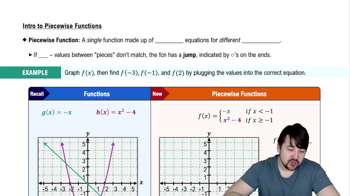
Identify the different segments of the piecewise function from the graph. Look for changes in the slope or direction of the graph, as well as any discontinuities or breaks.
For each segment, determine the type of function it represents (e.g., linear, quadratic, constant). This can often be done by observing the shape of the graph.
Write the equation for each segment. For a linear segment, use the slope-intercept form \( y = mx + b \), where \( m \) is the slope and \( b \) is the y-intercept. For other types of functions, use the appropriate form.
Determine the domain for each segment. This involves identifying the x-values over which each segment is defined. Pay attention to open and closed intervals, which are indicated by open or closed circles on the graph.
Combine the equations and their respective domains into a piecewise function. Use the format: \( f(x) = \begin{cases} \text{equation 1,} & \text{if } \text{domain 1} \\ \text{equation 2,} & \text{if } \text{domain 2} \\ \end{cases} \).
Verified video answer for a similar problem:
This video solution was recommended by our tutors as helpful for the problem above
Video duration:
4m
Play a video:
0 Comments
Key Concepts
Here are the essential concepts you must grasp in order to answer the question correctly.
Piecewise-Defined Functions
A piecewise-defined function is a function composed of multiple sub-functions, each of which applies to a specific interval of the domain. These functions are defined by different expressions based on the input value. Understanding how to interpret and construct these functions is crucial for analyzing graphs that change behavior at certain points.
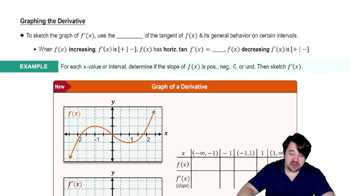
Interpreting a graph involves understanding the visual representation of a function, including identifying key features such as intercepts, slopes, and discontinuities. For piecewise functions, it's essential to recognize where the function changes its rule and how each segment corresponds to a different part of the function's definition.
Formulating a function from a graph requires translating visual information into mathematical expressions. This involves determining the equations for each segment of the graph, considering the slope and y-intercept for linear parts, and ensuring continuity or identifying points of discontinuity where applicable.