Ch. 1 - Functions
Hass - Thomas' Calculus 15th Edition
Hass15th EditionThomas' CalculusISBN: 9780137616077Not the one you use?Change textbook
Chapter 1, Problem 1.35

Piecewise-Defined Functions


In Exercises 35 and 36, find the (a) domain and (b) range.


𝔂 = { √ -x, -4 ≀ x ≀ 0
{ √ x, 0 < x ≀ 4

Verified step by step guidance
1
Step 1: Understand the piecewise function given. It consists of two parts: y = √(-x) for -4 ≀ x ≀ 0 and y = √x for 0 < x ≀ 4.
Step 2: Determine the domain of the function. The domain is the set of all x-values for which the function is defined. For y = √(-x), x must be between -4 and 0 inclusive. For y = √x, x must be between 0 and 4 inclusive. Combine these intervals to find the overall domain.
Step 3: Determine the range of the function. The range is the set of all possible y-values. For y = √(-x), as x goes from -4 to 0, y goes from 0 to 2. For y = √x, as x goes from 0 to 4, y goes from 0 to 2. Combine these ranges to find the overall range.
Step 4: Consider the endpoints of the intervals. For y = √(-x), when x = -4, y = √4 = 2, and when x = 0, y = √0 = 0. For y = √x, when x = 0, y = √0 = 0, and when x = 4, y = √4 = 2.
Step 5: Conclude the domain and range. The domain is [-4, 4] and the range is [0, 2]. Ensure that the function is continuous across the intervals and check for any discontinuities at the transition point x = 0.

Verified video answer for a similar problem:

This video solution was recommended by our tutors as helpful for the problem above.
Video duration:
5m
Was this helpful?

Key Concepts

Here are the essential concepts you must grasp in order to answer the question correctly.

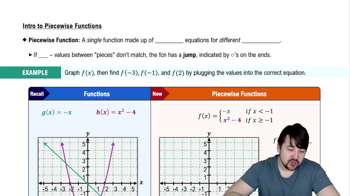
Piecewise Functions

Piecewise functions are defined by different expressions based on the input value. In this case, the function has two distinct parts: one for the interval from -4 to 0 and another for the interval from 0 to 4. Understanding how to evaluate these functions within their specified domains is crucial for determining their overall behavior.
Recommended video:
05:36
Piecewise Functions

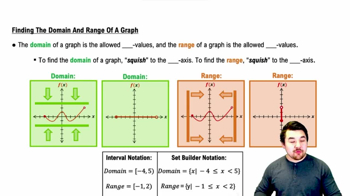
Domain

The domain of a function refers to the set of all possible input values (x-values) for which the function is defined. For the given piecewise function, the domain is determined by the intervals specified for each piece, which in this case are -4 to 0 and 0 to 4. Identifying the domain helps in understanding the valid inputs for the function.
Recommended video:
5:10
Finding the Domain and Range of a Graph

Range

The range of a function is the set of all possible output values (y-values) that the function can produce. To find the range of the piecewise function, one must evaluate the outputs of each piece over its respective domain. This involves calculating the minimum and maximum values of the function within the specified intervals.
Recommended video:
5:10
Finding the Domain and Range of a Graph