
A water trough for horses has a triangular cross section with a height of and horizontal side lengths of . The length of the trough is . How much work is required to pump the water to the top of the trough when it is half full.
Table of contents
- 0. Functions7h 54m
- Introduction to Functions16m
- Piecewise Functions10m
- Properties of Functions9m
- Common Functions1h 8m
- Transformations5m
- Combining Functions27m
- Exponent rules32m
- Exponential Functions28m
- Logarithmic Functions24m
- Properties of Logarithms36m
- Exponential & Logarithmic Equations35m
- Introduction to Trigonometric Functions38m
- Graphs of Trigonometric Functions44m
- Trigonometric Identities47m
- Inverse Trigonometric Functions48m
- 1. Limits and Continuity2h 2m
- 2. Intro to Derivatives1h 33m
- 3. Techniques of Differentiation3h 18m
- 4. Applications of Derivatives2h 38m
- 5. Graphical Applications of Derivatives6h 2m
- 6. Derivatives of Inverse, Exponential, & Logarithmic Functions2h 37m
- 7. Antiderivatives & Indefinite Integrals1h 26m
- 8. Definite Integrals4h 44m
- 9. Graphical Applications of Integrals2h 27m
- 10. Physics Applications of Integrals 3h 16m
- 11. Integrals of Inverse, Exponential, & Logarithmic Functions2h 34m
- 12. Techniques of Integration7h 41m
- 13. Intro to Differential Equations2h 55m
- 14. Sequences & Series5h 36m
- 15. Power Series2h 19m
- 16. Parametric Equations & Polar Coordinates7h 58m
10. Physics Applications of Integrals
Work
Problem 6.7.5
Textbook Question
Why is integration used to find the work required to pump water out of a tank?
Verified step by step guidance1
Understand that work is defined as the force applied times the distance over which it is applied. In the context of pumping water, the force is related to the weight of the water being moved.
Recognize that the tank contains water at different depths, and the amount of water at each depth may vary, so the force needed to move each small volume of water differs depending on its position.
Divide the water in the tank into thin horizontal slices, each with a small thickness \(\Delta y\), so that the weight of each slice can be approximated and the distance it must be lifted can be determined.
Express the work done to move each thin slice as the product of the weight of the slice and the distance it must be pumped, then sum these small amounts of work over all slices to approximate the total work.
Use integration to take the limit as the thickness of the slices approaches zero, turning the sum into an integral that accurately calculates the total work required to pump all the water out of the tank.
Verified video answer for a similar problem:This video solution was recommended by our tutors as helpful for the problem above
Video duration:
1mPlay a video:
Was this helpful?
Key Concepts
Here are the essential concepts you must grasp in order to answer the question correctly.
Work as an Integral of Force over Distance
Work is defined as the integral of force applied over a distance. When pumping water, the force varies with the amount of water and the height it must be lifted, so integration sums these infinitesimal contributions to find total work.
Recommended video:
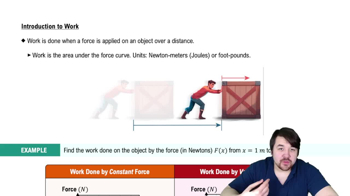
Introduction To Work
Variable Force Due to Changing Water Depth
The force needed to pump water depends on the weight of the water at different depths. Since water pressure and volume change with depth, the force is not constant, requiring integration to account for these variations.
Recommended video:
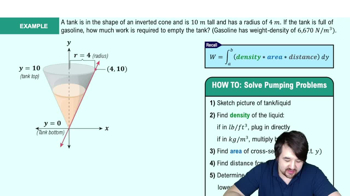
Pumping Liquids Example 2
Setting up the Integral Using Slices or Layers
To calculate work, the tank is divided into thin horizontal slices of water. Each slice requires a different amount of work to move it to the top, and integration sums the work for all slices to find the total.
Recommended video:
Integration Using Partial Fractions
Watch next
Master Introduction To Work with a bite sized video explanation from Patrick
Start learningRelated Videos
Related Practice
Multiple Choice
82
views
