
29–32. Intersection points Use algebraic methods to find as many intersection points of the following curves as possible. Use graphical methods to identify the remaining intersection points.
r = 2 cos θ and r = 1 + cos θ
Verified step by step guidance
1
Start by setting the two polar equations equal to each other to find the intersection points algebraically: \[2 \cos \theta = 1 + \cos \theta\].
Rearrange the equation to isolate terms: \[2 \cos \theta - \cos \theta = 1 \implies \cos \theta = 1\].
Solve for \[\theta\] where \[\cos \theta = 1\]. Recall that \[\cos \theta = 1\] at \[\theta = 0\] (and at multiples of \[2\pi\], but consider the principal values in the interval \[[0, 2\pi)\]).
Substitute \[\theta = 0\] back into either original equation to find the corresponding \[r\] value for the intersection point.
To find any additional intersection points that may not be captured by the algebraic method, use a graphical approach by plotting both curves \[r = 2 \cos \theta\] and \[r = 1 + \cos \theta\] over the interval \[\theta \in [0, 2\pi)\] and visually identify where they intersect.
Verified video answer for a similar problem:
This video solution was recommended by our tutors as helpful for the problem above
Video duration:
2m
Play a video:
0 Comments
Key Concepts
Here are the essential concepts you must grasp in order to answer the question correctly.
Polar Coordinates and Equations
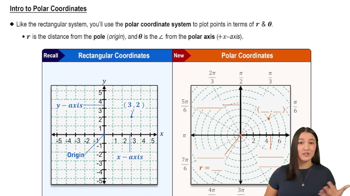
Polar coordinates represent points using a radius and an angle (r, θ) instead of Cartesian (x, y). Understanding how to interpret and manipulate polar equations like r = 2 cos θ is essential for finding points where two curves intersect.
Finding intersection points involves solving the system formed by the two given equations. In this case, equate r = 2 cos θ and r = 1 + cos θ, then solve algebraically for θ and r to find common solutions representing intersection points.
Graphing polar curves helps visualize intersections that may be difficult to find algebraically, especially when multiple solutions or complex angles are involved. Plotting r = 2 cos θ and r = 1 + cos θ reveals additional intersection points and confirms algebraic results.