
Textbook Question
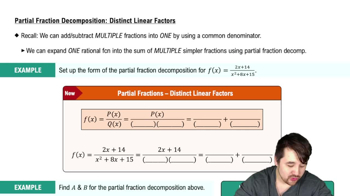
73. Two methods Evaluate ∫ dx/(x² - 1), for x > 1, in two ways: using partial fractions and a trigonometric substitution. Reconcile your two answers.
64
views

 Verified step by step guidance
 10:07
10:07
 06:11
06:11 07:33
07:3373. Two methods Evaluate ∫ dx/(x² - 1), for x > 1, in two ways: using partial fractions and a trigonometric substitution. Reconcile your two answers.
54–57. {Use of Tech} Comparing the Midpoint and Trapezoid Rules Compare the errors in the Midpoint and Trapezoid Rules with n = 4, 8, 16, and 32 subintervals when they are applied to the following integrals (with their exact values given).
59. ∫(from 0 to π) ln(5 + 3cosx) dx = π ln(9/2)
79. Tabular integration extended Refer to Exercise 77.
a. The following table shows the method of tabular integration applied to
∫ eˣ cos x dx.
Use the table to express ∫ eˣ cos x dx in terms of the sum of functions and an indefinite integral.
b. Solve the equation in part (a) for ∫ eʳ cos z dz.
c. Evaluate ∫ e⁻ᶻ sin 3z dz by applying the idea from parts (a) and (b).
85. Another form of ∫ sec x dx
a. Verify the identity:
sec x = cos x / (1 - sin² x)
b. Use the identity in part (a) to verify that:
∫ sec x dx = (1/2) ln |(1 + sin x)/(1 - sin x)| + C
Evaluate the following integrals.
∫ eˣ/(e²ˣ + 2eˣ + 17) dx
42-47. Volumes of Solids Find the volume of the solid generated when the given region is revolved as described.
42. The region bounded by f(x) = ln(x), y = 1, and the coordinate axes is revolved about the x-axis.