Geometry of integrals Without evaluating the integrals, explain why the following statement is true for positive integers n: β«βΒΉ πβΏdπ + β«βΒΉ βΏβ(πdπ) = 1
Verified step by step guidance
1
First, recognize that the problem involves two integrals over the interval from 0 to 1: \(\int_0^1 x^n \, dx\) and \(\int_0^1 \sqrt[n]{x} \, dx\), where \(n\) is a positive integer.
Recall the general formula for the integral of a power function: for any real number \(m > -1\), \(\int_0^1 x^m \, dx = \frac{1}{m+1}\).
Apply this formula to the first integral: since \(x^n\) is \(x\) raised to the power \(n\), we have \(\int_0^1 x^n \, dx = \frac{1}{n+1}\).
For the second integral, note that \(\sqrt[n]{x} = x^{1/n}\). Using the same formula, \(\int_0^1 x^{1/n} \, dx = \frac{1}{(1/n) + 1} = \frac{1}{\frac{n+1}{n}} = \frac{n}{n+1}\).
Add the two results together: \(\frac{1}{n+1} + \frac{n}{n+1} = \frac{1 + n}{n+1} = 1\). This shows why the sum of the two integrals equals 1 without evaluating the integrals explicitly.
Verified video answer for a similar problem:
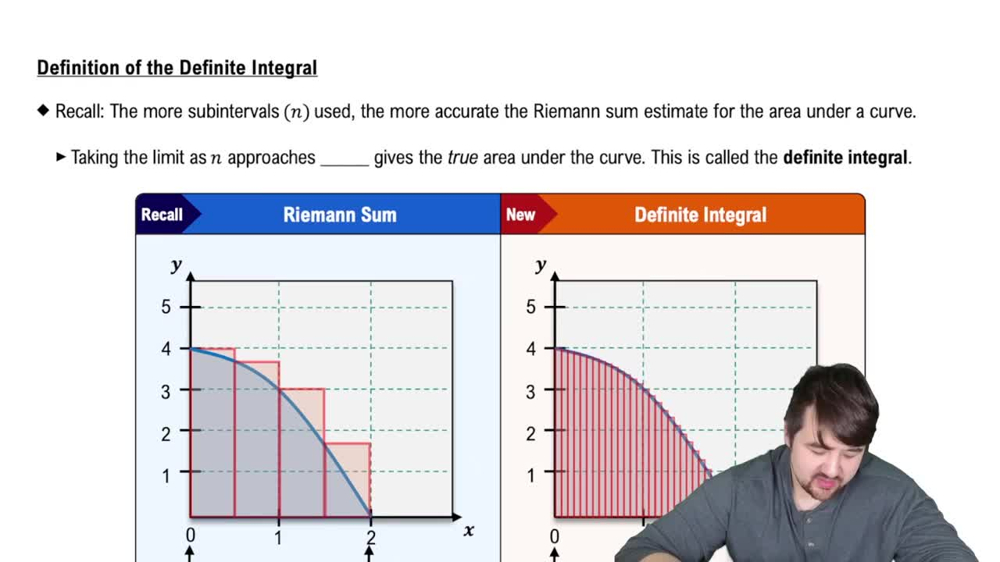
This video solution was recommended by our tutors as helpful for the problem above
Video duration:
4m
Play a video:
0 Comments
Key Concepts
Here are the essential concepts you must grasp in order to answer the question correctly.
Definite Integrals and Area Under the Curve
A definite integral from a to b represents the net area under the curve of a function between those limits. For positive functions, this area is positive and can be interpreted geometrically as the region bounded by the curve, the x-axis, and the vertical lines x = a and x = b.
Power functions of the form x^n, where n is a positive integer, have integrals that can be computed using the power rule. The integral β«βΒΉ x^n dx equals 1/(n+1), which decreases as n increases, reflecting how the area under x^n changes shape over [0,1].
Complementary Functions and Geometric Interpretation
The functions x^n and the nth root of x (x^(1/n)) are inverses in a geometric sense on [0,1]. Their integrals sum to 1 because the areas under their curves complement each other, filling the unit square between x=0 and x=1 without overlap, illustrating a symmetry in their graphs.