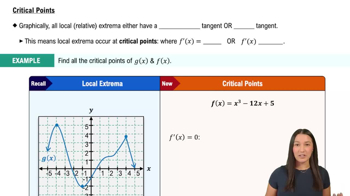
Textbook QuestionIdentifying ExtremaIn Exercises 41–52:a. Identify the function’s local extreme values in the given domain, and say where they occur.f(x) = √(x² − 2x − 3), 3 ≤ x < ∞127views
Textbook QuestionSketch the graph of a twice-differentiable function y=f(x) that passes through the points (-2,2), (-1,1), (0,0),(1,1), and (2,2) and whose first two derivatives have the following sign patterns.166views
Textbook QuestionIn Exercises 121–124, find the inflection points (if any) on the graph of the function and the coordinates of the points on the graph where the function has a local maximum or local minimum value. Then graph the function in a region large enough to show all these points simultaneously. Add to your picture the graphs of the function’s first and second derivatives. How are the values at which these graphs intersect the x-axis related to the graph of the function? In what other ways are the graphs of the derivatives related to the graph of the function?123. y=(4/5)x^5+16x^2-25150views
Textbook Question88. Given that x>0, find the maximum value, if any, ofc. x^(1/x^n) (n a positive integer)7views
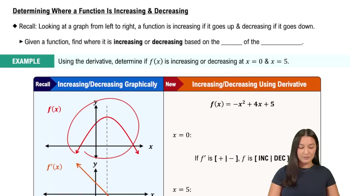
Multiple ChoiceIdentify the open intervals on which the function is increasing or decreasing.f(x)=3x4+8x3−18x2+7f(x)=3x^4+8x^3-18x^2+7f(x)=3x4+8x3−18x2+7401views3rank1comments
Multiple ChoiceIdentify the open intervals on which the function is increasing or decreasing.f(x)=x2/3(4−x)f(x)=x^{2/3}(4-x)f(x)=x2/3(4−x)276views2rank
Multiple ChoiceIdentify the intervals on which the function is increasing or decreasing.f(x)=sin2xf(x)=\(\sin\)^2xf(x)=sin2x on [0,π][0,\(\pi\)][0,π]264views3rank1comments