7–58. Improper integrals Evaluate the following integrals or state that they diverge. 33. ∫ (from 2 to ∞) 1/(y ln y) dy
Verified step by step guidance
1
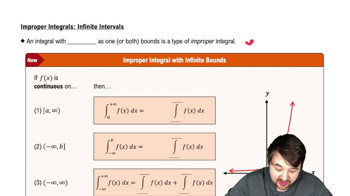
Identify the type of integral: This is an improper integral because the upper limit of integration is infinity, so we need to evaluate \( \int_{2}^{\infty} \frac{1}{y \ln y} \, dy \).
Rewrite the integral as a limit: Express the improper integral as \( \lim_{t \to \infty} \int_{2}^{t} \frac{1}{y \ln y} \, dy \) to handle the infinite upper bound.
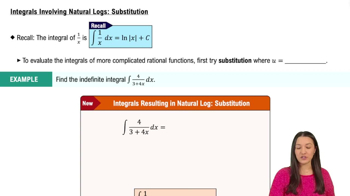
Use substitution to simplify the integral: Let \( u = \ln y \), then \( du = \frac{1}{y} dy \). This substitution transforms the integral into \( \int \frac{1}{u} du \).
Change the limits of integration according to the substitution: When \( y = 2 \), \( u = \ln 2 \); when \( y = t \), \( u = \ln t \). So the integral becomes \( \int_{\ln 2}^{\ln t} \frac{1}{u} du \).
Evaluate the integral and then take the limit: The integral \( \int \frac{1}{u} du \) is \( \ln |u| \), so evaluate \( \ln |u| \) from \( \ln 2 \) to \( \ln t \), then take the limit as \( t \to \infty \) to determine if the integral converges or diverges.
Verified video answer for a similar problem:
This video solution was recommended by our tutors as helpful for the problem above
Video duration:
4m
Play a video:
0 Comments
Key Concepts
Here are the essential concepts you must grasp in order to answer the question correctly.
Improper Integrals
Improper integrals involve integration over an infinite interval or integrands with infinite discontinuities. To evaluate them, the integral is expressed as a limit where the bound approaches infinity or the point of discontinuity. Convergence or divergence depends on whether this limit exists finitely.
Integrals containing logarithmic functions often require substitution techniques, such as setting u = ln(y), to simplify the integral. Understanding the behavior of ln(y) and its derivative is crucial for correctly transforming and evaluating these integrals.
Determining whether an improper integral converges involves comparing the integrand to known functions or using limit comparison tests. For example, integrals of the form 1/(y (ln y)^p) converge or diverge depending on the exponent p, which helps decide if the integral has a finite value.