5–24. For each of the following composite functions, find an inner function u=g(x) and an outer function y=f(u) such that y=f(g(x)). Then calculate dy/dx. y = e^√x
Verified step by step guidance
1
Identify the composite function structure: The given function is y = e^{\sqrt{x}}. This can be seen as a composition of two functions.
Choose the inner function: Let u = g(x) = \sqrt{x}. This represents the inner function, which is the square root of x.
Choose the outer function: Let y = f(u) = e^u. This represents the outer function, which is the exponential function with base e.
Differentiate the inner function: Find the derivative of u with respect to x, which is \frac{du}{dx} = \frac{1}{2\sqrt{x}}.
Differentiate the outer function: Find the derivative of y with respect to u, which is \frac{dy}{du} = e^u. Then, use the chain rule to find \frac{dy}{dx} = \frac{dy}{du} \cdot \frac{du}{dx}.
Verified video answer for a similar problem:
This video solution was recommended by our tutors as helpful for the problem above
Video duration:
6m
Play a video:
Was this helpful?
Key Concepts
Here are the essential concepts you must grasp in order to answer the question correctly.
Composite Functions
A composite function is formed when one function is applied to the result of another function. In the context of the question, we need to identify an inner function g(x) and an outer function f(u) such that the overall function can be expressed as y = f(g(x)). Understanding how to decompose a function into its components is essential for differentiation.
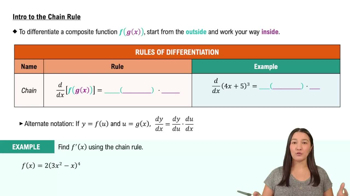
The chain rule is a fundamental principle in calculus used to differentiate composite functions. It states that if y = f(g(x)), then the derivative dy/dx can be calculated as dy/dx = f'(g(x)) * g'(x). This rule allows us to find the derivative of complex functions by breaking them down into simpler parts, making it crucial for solving the given problem.
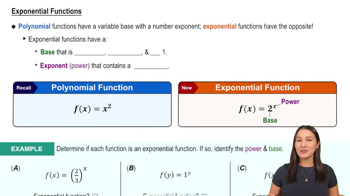
Exponential functions are mathematical functions of the form y = a^x, where 'a' is a constant and 'x' is the variable. In the given question, the function involves the exponential function e raised to the power of another function, √x. Understanding the properties of exponential functions, including their derivatives, is vital for accurately calculating dy/dx in this context.