
Ch. 10 - Sequences and Infinite Series
Briggs - Calculus: Early Transcendentals 3rd Edition
Briggs3rd EditionCalculus: Early TranscendentalsISBN: 9780136847243Not the one you use?Change textbook
Chapter 10, Problem 10.3.87f

87. Explain why or why not
Determine whether the following statements are true and give an explanation or counterexample.


f. If the series ∑ (k = 1 to ∞) aᵏ converges and |a| < |b|, then the series ∑ (k = 1 to ∞) bᵏ converges.

Verified step by step guidance
1
Step 1: Understand the problem statement. We are given that the series \( \sum_{k=1}^\infty a^k \) converges and that \( |a| < |b| \). We need to determine if this implies that the series \( \sum_{k=1}^\infty b^k \) also converges.
Step 2: Recall the convergence criteria for geometric series. A geometric series \( \sum_{k=1}^\infty r^k \) converges if and only if \( |r| < 1 \). If \( |r| \geq 1 \), the series diverges.
Step 3: Since \( \sum_{k=1}^\infty a^k \) converges, it follows that \( |a| < 1 \). This is because the series is geometric with ratio \( a \).
Step 4: Given \( |a| < |b| \), and knowing \( |a| < 1 \), it is possible that \( |b| \geq 1 \). If \( |b| \geq 1 \), then the series \( \sum_{k=1}^\infty b^k \) diverges by the geometric series test.
Step 5: Therefore, the statement is not necessarily true. A counterexample would be choosing \( a = 0.5 \) and \( b = 0.8 \) (both less than 1, so both series converge), but if \( b = 1.2 \), then \( |a| < |b| \) but \( \sum b^k \) diverges. Hence, the statement is false.

Verified video answer for a similar problem:

This video solution was recommended by our tutors as helpful for the problem above.
Video duration:
2m
Was this helpful?

Key Concepts

Here are the essential concepts you must grasp in order to answer the question correctly.

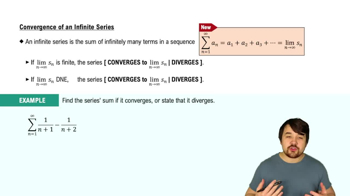
Convergence of Infinite Series

An infinite series converges if the sequence of its partial sums approaches a finite limit. For series involving powers, such as ∑ a^k, convergence depends on the value of the base a. Understanding convergence criteria is essential to determine whether a given series sums to a finite value.
Recommended video:
06:52
Convergence of an Infinite Series

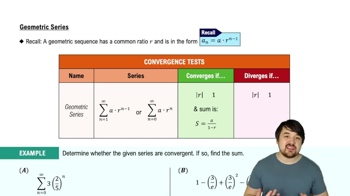
Geometric Series and Their Convergence

A geometric series ∑ r^k converges if and only if the absolute value of the common ratio |r| is less than 1. If |r| ≥ 1, the series diverges. This concept is crucial for analyzing series of the form ∑ a^k and ∑ b^k, as their convergence depends directly on the magnitude of a and b.
Recommended video:
06:00
Geometric Series

Comparison of Series Based on Term Magnitudes

Comparing series by the size of their terms can help infer convergence properties. However, a larger base in a geometric series does not guarantee convergence if the smaller base series converges. Understanding that convergence depends on the absolute value of the base, not just relative size, is key to evaluating the given statement.
Recommended video:
06:45
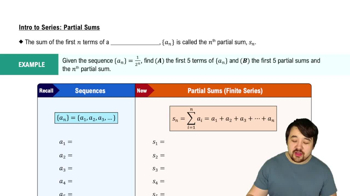
Intro to Series: Partial Sums