Derivative trick Here is an alternative way to evaluate higher derivatives of a function f that may save time. Suppose you can find the Taylor series for f centered at the point a without evaluating derivatives (for example, from a known series). Then f⁽ᵏ⁾(a)=k! multiplied by the coefficient of (x−a)ᵏ. Use this idea to evaluate f⁽³⁾(0) and f⁽⁴⁾(0) for the following functions. Use known series and do not evaluate derivatives.
f(x) = ∫₀ˣ sin t² dt
Verified step by step guidance
1
Recognize that the function is given by an integral: \(f(x) = \int_0^x \sin(t^2) \, dt\). To find the higher derivatives at 0 without directly differentiating, we will use the Taylor series expansion of \(\sin(t^2)\) around 0.
Recall the Taylor series for \(\sin z\) centered at 0: \(\sin z = \sum_{n=0}^\infty (-1)^n \frac{z^{2n+1}}{(2n+1)!}\). Substitute \(z = t^2\) to get the series for \(\sin(t^2)\): \(\sin(t^2) = \sum_{n=0}^\infty (-1)^n \frac{t^{4n+2}}{(2n+1)!}\).
Integrate the series term-by-term from 0 to \(x\) to find the series for \(f(x)\): \(f(x) = \int_0^x \sin(t^2) \, dt = \sum_{n=0}^\infty (-1)^n \frac{1}{(2n+1)!} \int_0^x t^{4n+2} \, dt\). Perform the integral inside the sum to get \(f(x) = \sum_{n=0}^\infty (-1)^n \frac{x^{4n+3}}{(2n+1)! (4n+3)}\).
Identify the coefficients of the powers of \(x\) in the series expansion of \(f(x)\): the general term is \(a_n x^{4n+3}\) where \(a_n = (-1)^n / [(2n+1)! (4n+3)]\). Since the series is centered at 0, the coefficient of \(x^k\) corresponds to the coefficient of \((x-0)^k\).
Use the formula for the \(k\)-th derivative at 0: \(f^{(k)}(0) = k!\) times the coefficient of \(x^k\) in the Taylor series. To find \(f^{(3)}(0)\) and \(f^{(4)}(0)\), locate the coefficients of \(x^3\) and \(x^4\) respectively in the series and multiply each by \$3!\( and \)4!$. Note that if a power does not appear in the series, the corresponding derivative at 0 is zero.
Verified video answer for a similar problem:
This video solution was recommended by our tutors as helpful for the problem above
Video duration:
6m
Play a video:
Was this helpful?
Key Concepts
Here are the essential concepts you must grasp in order to answer the question correctly.
Taylor Series Expansion
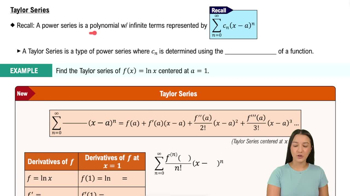
A Taylor series represents a function as an infinite sum of terms calculated from the function's derivatives at a single point. It expresses f(x) as a power series centered at a point a, allowing approximation of the function near a. Each term involves powers of (x - a) and coefficients related to derivatives of f at a.
Relationship Between Taylor Coefficients and Derivatives
The coefficient of the (x - a)^k term in the Taylor series of f(x) is equal to f^(k)(a) divided by k!. This means the k-th derivative at a can be found by multiplying the coefficient of (x - a)^k by k!, providing a shortcut to find derivatives if the series is known.
Using Known Series to Find Derivatives of Integral Functions
When a function is defined as an integral of another function with a known series (e.g., f(x) = ∫₀ˣ sin(t²) dt), you can find its Taylor series by integrating the series term-by-term. This avoids direct differentiation and allows extraction of derivatives from the resulting power series.