Ch. 11 - Power Series
Briggs - Calculus: Early Transcendentals 3rd Edition
Briggs3rd EditionCalculus: Early TranscendentalsISBN: 9780136847243Not the one you use?Change textbook
Chapter 11, Problem 11.1.49

{Use of Tech} Estimating errors Use the remainder to find a bound on the error in approximating the following quantities with the nth-order Taylor polynomial centered at 0. Estimates are not unique.


e⁰ᐧ²⁵, n=4

Verified step by step guidance
1
Identify the function to approximate: here, it is \(f(x) = e^x\), and we want to approximate \(e^{0.25}\) using the 4th-order Taylor polynomial centered at 0.
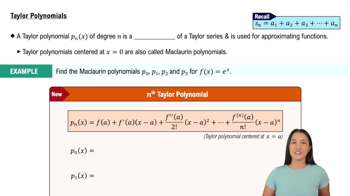
Recall the Taylor polynomial of order \(n\) for \(f(x)\) centered at 0 is given by: \[T_n(x) = \sum_{k=0}^n \frac{f^{(k)}(0)}{k!} x^k,\] where \(f^{(k)}(0)\) is the \(k\)th derivative of \(f\) evaluated at 0.
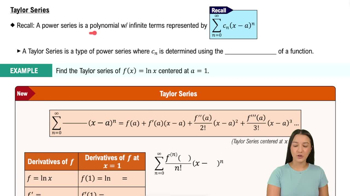
The remainder (error) term for the Taylor polynomial approximation is given by the Lagrange form: \[R_n(x) = \frac{f^{(n+1)}(c)}{(n+1)!} x^{n+1}\] for some \(c\) between 0 and \(x\).
Since \(f(x) = e^x\), all derivatives are \(e^x\), which are positive and increasing. To find an upper bound on the error, evaluate the maximum of \(|f^{(n+1)}(c)|\) on the interval between 0 and 0.25, which is \(e^{0.25}\) because \(e^x\) is increasing.
Substitute \(n=4\), \(x=0.25\), and the maximum derivative value into the remainder formula to get the error bound: \[|R_4(0.25)| \leq \frac{e^{0.25}}{5!} (0.25)^5.\] This expression gives a bound on the error when approximating \(e^{0.25}\) with the 4th-order Taylor polynomial centered at 0.

Verified video answer for a similar problem:

This video solution was recommended by our tutors as helpful for the problem above.
Video duration:
4m
Was this helpful?

Key Concepts

Here are the essential concepts you must grasp in order to answer the question correctly.

Taylor Polynomial Approximation

A Taylor polynomial approximates a function near a point using a finite sum of its derivatives at that point. The nth-order Taylor polynomial centered at 0 (Maclaurin polynomial) uses derivatives up to order n to estimate the function's value close to zero.
Recommended video:
07:00
Taylor Polynomials

Remainder (Error) Term in Taylor Series

The remainder term quantifies the difference between the actual function value and its Taylor polynomial approximation. It provides an upper bound on the error, often expressed using the Lagrange form involving the (n+1)th derivative evaluated at some point in the interval.
Recommended video:
08:42
Taylor Series

Bounding the Error for Exponential Functions

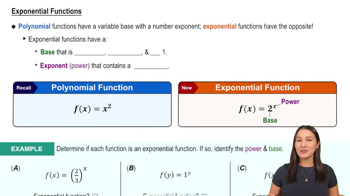
For functions like e^x, all derivatives are e^x, which are positive and increasing for positive x. To bound the error, evaluate the maximum value of the (n+1)th derivative on the interval from 0 to the point of approximation, ensuring the error estimate is valid.
Recommended video:
6:13
Exponential Functions