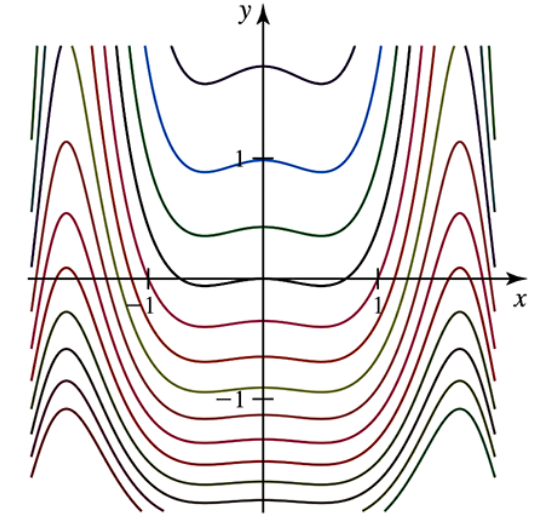
42–43. Implicit solutions for separable equations For the following separable equations, carry out the indicated analysis. a. Find the general solution of the equation.
Rewrite the given differential equation \(e^{-\frac{y}{2}} y'(x) = 4x \sin(x^2) - x\) in the form \(\frac{dy}{dx} = e^{\frac{y}{2}} (4x \sin(x^2) - x)\) to isolate \(y'\) on one side.
Recognize that the equation is separable, so rearrange terms to separate variables: \(e^{-\frac{y}{2}} dy = (4x \sin(x^2) - x) dx\).
Integrate both sides: \(\int e^{-\frac{y}{2}} dy = \int (4x \sin(x^2) - x) dx\). For the left side, use substitution \(u = -\frac{y}{2}\); for the right side, split the integral into two parts and use substitution for \(\int 4x \sin(x^2) dx\).
After integrating, include the constant of integration \(C\) and write the implicit general solution relating \(y\) and \(x\).
Use the given initial conditions \(y(0) = 0\), \(y(0) = \ln(\frac{1}{4})\), and \(y(\sqrt{\frac{\pi}{2}}) = 0\) to solve for the constant \(C\) and verify the solution's consistency.
Verified video answer for a similar problem:
This video solution was recommended by our tutors as helpful for the problem above
Video duration:
7m
Play a video:
0 Comments
Key Concepts
Here are the essential concepts you must grasp in order to answer the question correctly.
Separable Differential Equations
A separable differential equation can be written as the product of a function of x and a function of y, allowing the variables to be separated on opposite sides of the equation. This enables integration with respect to each variable independently, facilitating the solution of the differential equation.
An implicit solution to a differential equation is a relation involving both x and y that defines y implicitly as a function of x. Unlike explicit solutions, implicit solutions may not isolate y on one side but still satisfy the differential equation and initial conditions.
Initial conditions specify the value of the solution at a particular point, allowing determination of the constant of integration in the general solution. Applying these conditions yields a unique particular solution that fits the given problem context.