
Step 1: Recognize that the function x^(x^10) is a composite function involving both a power and an exponential term. To differentiate it, use the logarithmic differentiation technique.
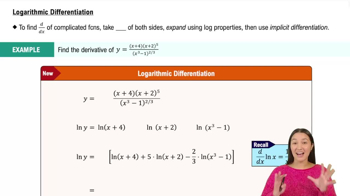
Step 2: Let y = x^(x^10). Take the natural logarithm of both sides: ln(y) = ln(x^(x^10)). Simplify using logarithmic properties: ln(y) = x^10 * ln(x).
Step 3: Differentiate both sides with respect to x. For the left-hand side, use implicit differentiation: (1/y) * dy/dx. For the right-hand side, apply the product rule to differentiate x^10 * ln(x).
Step 4: The derivative of x^10 * ln(x) is (x^10)' * ln(x) + x^10 * (ln(x))'. Compute these derivatives: (x^10)' = 10x^9 and (ln(x))' = 1/x.
Step 5: Substitute the derivatives back into the equation and solve for dy/dx. Multiply through by y (which is x^(x^10)) to express the derivative in terms of the original function.
Verified video answer for a similar problem:
This video solution was recommended by our tutors as helpful for the problem above
Video duration:
3m
Play a video:
0 Comments
Key Concepts
Here are the essential concepts you must grasp in order to answer the question correctly.
Chain Rule
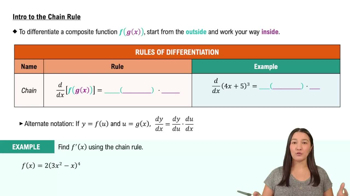
The Chain Rule is a fundamental differentiation technique used to find the derivative of composite functions. It states that if a function y is composed of another function u, then the derivative of y with respect to x can be found by multiplying the derivative of y with respect to u by the derivative of u with respect to x. This rule is essential for evaluating derivatives of functions where one function is nested within another.
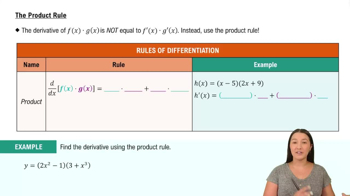
The Product Rule is a method for differentiating products of two functions. It states that if you have two functions u(x) and v(x), the derivative of their product is given by u'v + uv'. This rule is particularly useful when dealing with functions that are multiplied together, such as in the case of x raised to a power that is also a function of x.
Exponential Functions and Logarithmic Differentiation
Exponential functions, particularly those of the form f(x) = x^g(x), can be differentiated using logarithmic differentiation. This technique involves taking the natural logarithm of both sides, which simplifies the differentiation process, especially when the exponent is a function of x. By applying the properties of logarithms, one can transform the expression into a more manageable form for differentiation.