
What is the polar equation of the vertical line x = 5?
Verified step by step guidance
1
Recall the relationship between Cartesian coordinates \((x, y)\) and polar coordinates \((r, \theta)\): \(x = r \cos{\theta}\) and \(y = r \sin{\theta}\).
Given the vertical line \(x = 5\), substitute \(x\) with \(r \cos{\theta}\) to rewrite the equation in polar form: \(r \cos{\theta} = 5\).
To express \(r\) explicitly, solve for \(r\): \(r = \frac{5}{\cos{\theta}}\).
Recognize that \(\frac{1}{\cos{\theta}}\) is \(\sec{\theta}\), so the polar equation can also be written as \(r = 5 \sec{\theta}\).
Note that this equation represents all points where the radius \(r\) and angle \(\theta\) satisfy the condition for the vertical line \(x=5\) in polar coordinates.
Verified video answer for a similar problem:
This video solution was recommended by our tutors as helpful for the problem above
Video duration:
1m
Play a video:
Was this helpful?
Key Concepts
Here are the essential concepts you must grasp in order to answer the question correctly.
Polar Coordinates
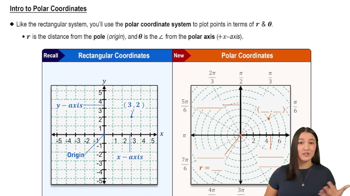
Polar coordinates represent points in the plane using a radius and an angle, denoted as (r, θ), where r is the distance from the origin and θ is the angle measured from the positive x-axis. This system is useful for describing curves and lines in terms of angles and distances rather than x and y coordinates.
Conversion Between Cartesian and Polar Coordinates
To convert between Cartesian (x, y) and polar (r, θ) coordinates, use the formulas x = r cos(θ) and y = r sin(θ). These relationships allow us to rewrite equations given in x and y into polar form by substituting x and y with their polar equivalents.
A vertical line x = a in Cartesian coordinates can be expressed in polar form by substituting x = r cos(θ). Thus, the equation becomes r cos(θ) = a, which relates r and θ for points on the vertical line. This form helps analyze and graph vertical lines using polar coordinates.