Power Rule for negative integers Use the Derivative Quotient Rule to prove the Power Rule for negative integers, that is, d/dx (x⁻ᵐ) = −mx⁻ᵐ⁻¹ where m is a positive integer.
Verified step by step guidance
1
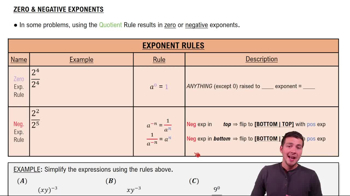
Start by expressing the function x^(-m) as a fraction: x^(-m) = 1/x^m.
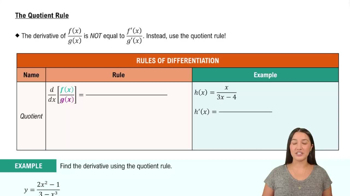
Apply the Quotient Rule for derivatives, which states that if you have a function in the form of u/v, the derivative is (v * du/dx - u * dv/dx) / v^2.
Set u = 1 and v = x^m. Then, compute the derivatives: du/dx = 0 and dv/dx = m * x^(m-1).
Substitute these into the Quotient Rule formula: (x^m * 0 - 1 * m * x^(m-1)) / (x^m)^2.
Simplify the expression: -m * x^(m-1) / x^(2m) = -m * x^(-m-1), which proves the Power Rule for negative integers.
Verified video answer for a similar problem:
This video solution was recommended by our tutors as helpful for the problem above
Video duration:
3m
Play a video:
Was this helpful?
Key Concepts
Here are the essential concepts you must grasp in order to answer the question correctly.
Derivative Quotient Rule
The Quotient Rule is a method for finding the derivative of a function that is the ratio of two differentiable functions. If you have a function f(x) = g(x)/h(x), the derivative f'(x) is given by (g'(x)h(x) - g(x)h'(x)) / (h(x))^2. This rule is essential for differentiating functions expressed as fractions, such as x⁻ᵐ, which can be rewritten as 1/xᵐ.
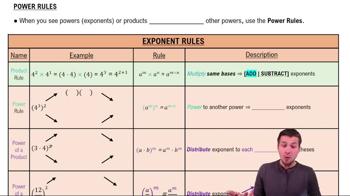
The Power Rule is a basic rule in calculus for finding the derivative of a function of the form f(x) = xⁿ, where n is any real number. The derivative is given by f'(x) = nxⁿ⁻¹. This rule simplifies the process of differentiation and is fundamental for understanding how to handle powers of x, including negative powers.
Negative integer exponents indicate the reciprocal of the base raised to the corresponding positive exponent. For example, x⁻ᵐ is equivalent to 1/xᵐ. Understanding this concept is crucial when applying the Power Rule to negative exponents, as it involves rewriting the expression in a form suitable for differentiation using the Quotient Rule.