
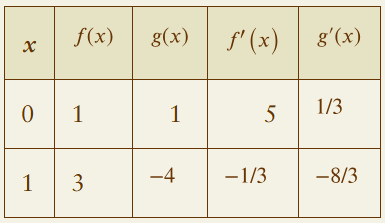
Suppose that the functions f and g and their derivatives with respect to x have the following values at x = 0 and x = 1.
Find the derivatives with respect to x of the following combinations at the given value of x.
c. f(x) / (g(x) + 1), x = 1
Verified step by step guidance
1
Step 1: Recognize that the function to differentiate is f(x) / (g(x) + 1). To find its derivative, use the quotient rule: (u/v)' = (u'v - uv') / v^2, where u = f(x) and v = g(x) + 1.
Step 2: Compute u' and v'. From the table, u = f(x) and u' = f'(x). Similarly, v = g(x) + 1, so v' = g'(x). Use the values at x = 1: f'(x) = -1/3 and g'(x) = -8/3.
Step 3: Substitute the values of u, u', v, and v' into the quotient rule formula. At x = 1, u = f(x) = 3, v = g(x) + 1 = -4 + 1 = -3, u' = -1/3, and v' = -8/3.
Step 4: Plug these values into the formula: (u/v)' = [(u' * v) - (u * v')]/v^2. This becomes [(-1/3 * -3) - (3 * -8/3)] / (-3)^2.
Step 5: Simplify the numerator and denominator separately. The numerator involves multiplication and subtraction, while the denominator is the square of v. Combine these results to express the derivative.
Verified video answer for a similar problem:
This video solution was recommended by our tutors as helpful for the problem above
Video duration:
6m
Play a video:
Was this helpful?
Key Concepts
Here are the essential concepts you must grasp in order to answer the question correctly.
Quotient Rule
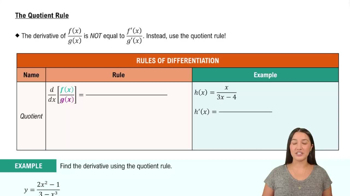
The quotient rule is used to find the derivative of a function that is the quotient of two differentiable functions. If you have a function h(x) = f(x)/g(x), the derivative h'(x) is given by [g(x)f'(x) - f(x)g'(x)] / [g(x)]^2. This rule is essential for differentiating the given function f(x) / (g(x) + 1).
Derivative evaluation involves substituting specific values into the derivative formula to find the rate of change at a particular point. In this problem, you need to evaluate the derivative of the function at x = 1 using the values provided in the table for f(x), g(x), f'(x), and g'(x). This step is crucial for obtaining the final numerical result.
Function composition involves combining two functions to form a new function, such as f(x) / (g(x) + 1). Understanding how to manipulate and differentiate composed functions is key to solving this problem, as it requires applying the quotient rule to a function that includes a sum in the denominator.