Ch. 5 - Integration
Briggs - Calculus: Early Transcendentals 3rd Edition
Briggs3rd EditionCalculus: Early TranscendentalsISBN: 9780136847243Not the one you use?Change textbook
Chapter 5, Problem 5.2.45

Definite integrals Use geometry (not Riemann sums) to evaluate the following definite integrals. Sketch a graph of the integrand, show the region in question, and interpret your result.


 ∫₀⁴ ƒ(𝓍) d𝓍, where ƒ(𝓍) = {5      if 𝓍 ≤ 2                                                                                                                                                                                     
                      3𝓍 ― 1  if 𝓍 > 2

Verified step by step guidance
1
Step 1: Understand the problem. The definite integral ∫₀⁴ ƒ(𝓍) d𝓍 involves a piecewise function ƒ(𝓍), which is defined as 5 for 𝓍 ≤ 2 and 3𝓍 - 1 for 𝓍 > 2. The goal is to evaluate the integral geometrically by sketching the graph of ƒ(𝓍) and calculating the area under the curve between 𝓍 = 0 and 𝓍 = 4.
Step 2: Sketch the graph of ƒ(𝓍). For 𝓍 ≤ 2, ƒ(𝓍) = 5 is a horizontal line at y = 5. For 𝓍 > 2, ƒ(𝓍) = 3𝓍 - 1 is a linear function with slope 3 and y-intercept -1. Plot these two segments on the graph, ensuring continuity at 𝓍 = 2.
Step 3: Identify the regions under the curve. From 𝓍 = 0 to 𝓍 = 2, the region is a rectangle with height 5 and width 2. From 𝓍 = 2 to 𝓍 = 4, the region is a trapezoid formed by the linear function ƒ(𝓍) = 3𝓍 - 1.
Step 4: Calculate the area of each region. For the rectangle (𝓍 = 0 to 𝓍 = 2), the area is given by the formula for the area of a rectangle: width × height. For the trapezoid (𝓍 = 2 to 𝓍 = 4), use the formula for the area of a trapezoid: (1/2) × (base₁ + base₂) × height, where base₁ and base₂ are the values of ƒ(𝓍) at 𝓍 = 2 and 𝓍 = 4, respectively.
Step 5: Add the areas of the two regions to find the total area under the curve. This total area represents the value of the definite integral ∫₀⁴ ƒ(𝓍) d𝓍.

Verified video answer for a similar problem:

This video solution was recommended by our tutors as helpful for the problem above.
Video duration:
4m
Was this helpful?

Key Concepts

Here are the essential concepts you must grasp in order to answer the question correctly.

Definite Integrals

A definite integral represents the signed area under a curve defined by a function over a specific interval. It is denoted as ∫_a^b f(x) dx, where 'a' and 'b' are the limits of integration. The value of a definite integral can be interpreted geometrically as the area between the curve and the x-axis, taking into account the regions above and below the axis.
Recommended video:
05:43
Definition of the Definite Integral

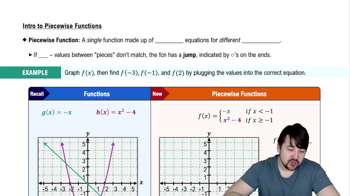
Piecewise Functions

A piecewise function is defined by different expressions based on the input value. In this case, the function f(x) has two distinct expressions: f(x) = 5 for x ≤ 2 and f(x) = 3x - 1 for x > 2. Understanding how to evaluate piecewise functions is crucial for determining the area under the curve accurately across the specified interval.
Recommended video:
05:36
Piecewise Functions

Geometric Interpretation of Integrals

The geometric interpretation of integrals involves visualizing the area under the curve of a function. By sketching the graph of the integrand, one can identify the regions contributing to the integral's value. This approach allows for a more intuitive understanding of the integral as the total area, rather than relying solely on algebraic methods like Riemann sums.
Recommended video:
Guided course
04:18
Geometric Sequences - Recursive Formula
Related Practice
Textbook Question

Area Find (i) the net area and (ii) the area of the following regions. Graph the function and indicate the region in question.


The region bounded by y = 6 cos 𝓍 and the 𝓍-axis between 𝓍 = ―π/2 and 𝓍 = π

103
views

Textbook Question

Average distance on a parabola What is the average distance between the parabola y = 30𝓍 (20 ― 𝓍 ) and the 𝓍-axis on the interval [0, 20] ?

123
views
Textbook Question

Evaluating integrals Evaluate the following integrals.


∫₁⁴ ((√v + v) / v ) dv

70
views
Textbook Question

Consider the function

ƒ(t) = { t      if  ―2 ≤ t < 0

t²/2    if    0 ≤ t ≤ 2                                                                                                                                                                       

and its graph shown below. Let F(𝓍) = ∫₋₁ˣ ƒ(t) dt and G(𝓍) = ∫₋₂ˣ ƒ(t) dt.

(f) Find a constant C such that F(𝓍) = G(𝓍) + C .

48
views
Textbook Question

Evaluating integrals Evaluate the following integrals.


∫₀⁵ |2𝓍―8|d𝓍

49
views
Textbook Question

Variations on the substitution method Evaluate the following integrals.                                                                                                        


 ∫ (eˣ ― e⁻ˣ)/ (eˣ + e⁻ˣ) d𝓍

42
views