Assume that functions f and g are differentiable with f(2) = 3, f'(2) = −1, g(2) = −4, and g'(2) = 1. Find an equation of the line perpendicular to the line tangent to the graph of F(x) = (f(x) + 3) / (x − g(x)) at x = 2.
Table of contents
- 0. Functions7h 54m
- Introduction to Functions16m
- Piecewise Functions10m
- Properties of Functions9m
- Common Functions1h 8m
- Transformations5m
- Combining Functions27m
- Exponent rules32m
- Exponential Functions28m
- Logarithmic Functions24m
- Properties of Logarithms36m
- Exponential & Logarithmic Equations35m
- Introduction to Trigonometric Functions38m
- Graphs of Trigonometric Functions44m
- Trigonometric Identities47m
- Inverse Trigonometric Functions48m
- 1. Limits and Continuity2h 2m
- 2. Intro to Derivatives1h 33m
- 3. Techniques of Differentiation3h 18m
- 4. Applications of Derivatives2h 38m
- 5. Graphical Applications of Derivatives6h 2m
- 6. Derivatives of Inverse, Exponential, & Logarithmic Functions2h 37m
- 7. Antiderivatives & Indefinite Integrals1h 26m
- 8. Definite Integrals4h 44m
- 9. Graphical Applications of Integrals2h 27m
- 10. Physics Applications of Integrals 3h 16m
- 11. Integrals of Inverse, Exponential, & Logarithmic Functions2h 34m
- 12. Techniques of Integration7h 41m
- 13. Intro to Differential Equations2h 55m
- 14. Sequences & Series5h 36m
- 15. Power Series2h 19m
- 16. Parametric Equations & Polar Coordinates7h 58m
3. Techniques of Differentiation
Product and Quotient Rules
Problem 8.8.67b
Textbook Question
66–71. {Use of Tech} Estimating error Refer to Theorem 8.1 in the following exercises.
67. Let f(x) = √(x³ + 1).
b. Calculate f''(x).
Verified step by step guidance1
Step 1: Recall the function f(x) = √(x³ + 1). To calculate f''(x), we first need to find f'(x), the first derivative of f(x). Use the chain rule for differentiation since f(x) involves a composition of functions.
Step 2: Start by differentiating the outer function √(u), where u = x³ + 1. The derivative of √(u) is (1 / (2√(u))) * du/dx. Substitute u = x³ + 1 into this formula.
Step 3: Differentiate the inner function x³ + 1 with respect to x. The derivative of x³ is 3x², and the derivative of 1 is 0. Therefore, du/dx = 3x².
Step 4: Combine the results from Step 2 and Step 3 to find f'(x). Substitute du/dx = 3x² into the formula for the derivative of √(u). This gives f'(x) = (1 / (2√(x³ + 1))) * 3x².
Step 5: To find f''(x), differentiate f'(x) = (3x² / (2√(x³ + 1))) using the quotient rule. The quotient rule states that if h(x) = g(x) / k(x), then h'(x) = (g'(x)k(x) - g(x)k'(x)) / [k(x)]². Apply this rule carefully to f'(x), treating the numerator and denominator separately.
Verified video answer for a similar problem:This video solution was recommended by our tutors as helpful for the problem above
Video duration:
5mPlay a video:
Was this helpful?
Key Concepts
Here are the essential concepts you must grasp in order to answer the question correctly.
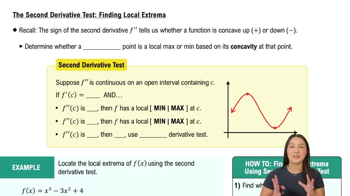
Second Derivative
The second derivative of a function, denoted as f''(x), measures the rate of change of the first derivative, f'(x). It provides information about the concavity of the function: if f''(x) is positive, the function is concave up, and if negative, it is concave down. This concept is crucial for understanding the behavior of functions and for applications in optimization and curve sketching.
Recommended video:
The Second Derivative Test: Finding Local Extrema
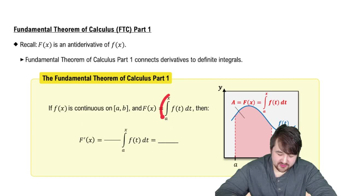
Theorem 8.1
Theorem 8.1 typically refers to a specific theorem in calculus that deals with estimating errors in approximations, often related to Taylor series or numerical methods. Understanding this theorem is essential for evaluating how closely a function can be approximated by its derivatives, which is particularly relevant when calculating the second derivative and assessing the accuracy of such calculations.
Recommended video:
Fundamental Theorem of Calculus Part 1
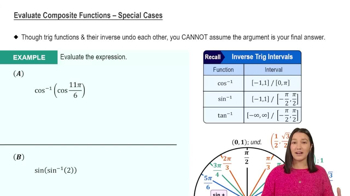
Function Composition and Roots
The function f(x) = √(x³ + 1) involves both composition and roots. Understanding how to differentiate composite functions and apply the chain rule is vital for finding derivatives. Additionally, recognizing how to manipulate roots and powers is necessary for simplifying expressions and performing calculations accurately, especially when deriving higher-order derivatives.
Recommended video:
Evaluate Composite Functions - Special Cases
Related Videos
Related Practice
Textbook Question
111
views