Determine the interval(s) on which the following functions are continuous. At which finite endpoints of the intervals of continuity is f continuous from the left or continuous from the right?
f(x)=√25−x^2
Verified step by step guidance
1
The function \( f(x) = \sqrt{25 - x^2} \) is defined when the expression under the square root is non-negative. Therefore, solve the inequality \( 25 - x^2 \geq 0 \).
Rearrange the inequality to \( x^2 \leq 25 \). This implies \( -5 \leq x \leq 5 \). Thus, the domain of \( f(x) \) is the closed interval \([-5, 5]\).
The function \( f(x) = \sqrt{25 - x^2} \) is continuous wherever it is defined, as it is a composition of continuous functions (a polynomial and a square root function). Therefore, \( f(x) \) is continuous on the open interval \((-5, 5)\).
At \( x = -5 \) and \( x = 5 \), check the one-sided limits. For \( x = -5 \), check if \( \lim_{x \to -5^+} f(x) = f(-5) \). For \( x = 5 \), check if \( \lim_{x \to 5^-} f(x) = f(5) \).
If the one-sided limits equal the function values at \( x = -5 \) and \( x = 5 \), then \( f(x) \) is continuous from the right at \( x = -5 \) and continuous from the left at \( x = 5 \).
Verified video answer for a similar problem:
This video solution was recommended by our tutors as helpful for the problem above
Video duration:
3m
Play a video:
Was this helpful?
Key Concepts
Here are the essential concepts you must grasp in order to answer the question correctly.
Continuity of Functions
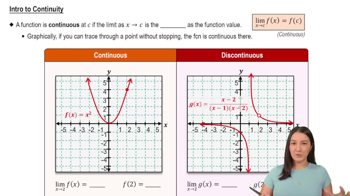
A function is continuous at a point if the limit of the function as it approaches that point equals the function's value at that point. For a function to be continuous over an interval, it must be continuous at every point within that interval. This concept is crucial for determining where a function does not have breaks, jumps, or asymptotes.
Endpoints of intervals are the boundary points that define the start and end of an interval. When analyzing continuity, it is important to check the behavior of the function at these endpoints, as a function can be continuous from the left or right at these points. This means we need to evaluate one-sided limits to determine continuity at the endpoints.
Finding Global Extrema (Extreme Value Theorem) Example 4
Square Root Function
The square root function, such as f(x) = √(25 - x^2), is defined only for non-negative values under the square root. This means that the expression inside the square root must be greater than or equal to zero for the function to be real-valued. Understanding the domain of the square root function is essential for identifying the intervals of continuity.