Determine the interval(s) on which the following functions are continuous. p(x)=4x^5−3x^2+1
Verified step by step guidance
1
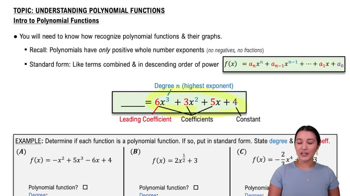
p>Step 1: Recognize that the function \( p(x) = 4x^5 - 3x^2 + 1 \) is a polynomial function.
p>Step 2: Recall that polynomial functions are continuous everywhere on the real number line.
p>Step 3: Conclude that the function \( p(x) \) is continuous for all real numbers.
p>Step 4: Express the interval of continuity for \( p(x) \) as \((-\infty, \infty)\).
p>Step 5: Verify that there are no restrictions or discontinuities in the function \( p(x) \).
Verified video answer for a similar problem:
This video solution was recommended by our tutors as helpful for the problem above
Video duration:
2m
Play a video:
Was this helpful?
Key Concepts
Here are the essential concepts you must grasp in order to answer the question correctly.
Continuity of Functions
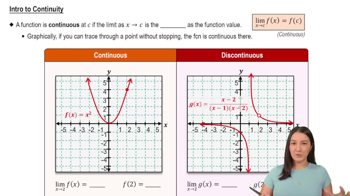
A function is continuous at a point if the limit of the function as it approaches that point equals the function's value at that point. For a function to be continuous over an interval, it must be continuous at every point within that interval. This means there are no breaks, jumps, or asymptotes in the function's graph.
Polynomial functions, like p(x) = 4x^5 - 3x^2 + 1, are continuous everywhere on the real number line. This is because they are composed of terms that are powers of x with real coefficients, which do not introduce any discontinuities. Understanding the nature of polynomial functions is crucial for determining their continuity.
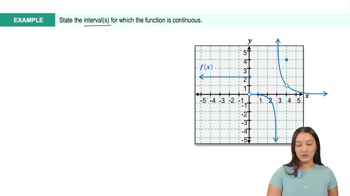
Intervals of continuity refer to the ranges of x-values over which a function remains continuous. For polynomial functions, the interval of continuity is typically all real numbers, denoted as (-∞, ∞). Identifying these intervals involves analyzing the function's behavior and ensuring it meets the criteria for continuity across the specified range.