Identify the limit expression: \( \lim_{x \to 0} (2\sin x - 1) \).
Recall the basic limit property for sine: \( \lim_{x \to 0} \sin x = 0 \).
Substitute the limit of \( \sin x \) into the expression: \( 2(\lim_{x \to 0} \sin x) - 1 \).
Simplify the expression using the known limit: \( 2(0) - 1 \).
Conclude the limit evaluation by simplifying the expression to find the result.
Verified video answer for a similar problem:
This video solution was recommended by our tutors as helpful for the problem above
Video duration:
1m
Play a video:
0 Comments
Key Concepts
Here are the essential concepts you must grasp in order to answer the question correctly.
Limits
Limits are fundamental in calculus, representing the value that a function approaches as the input approaches a certain point. They are essential for understanding continuity, derivatives, and integrals. In this context, we are interested in the limit of the function as x approaches 0, which helps determine the behavior of the function near that point.
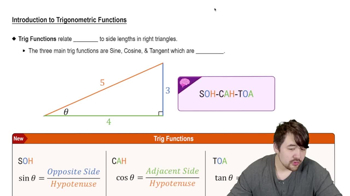
Trigonometric functions, such as sine and cosine, relate angles to ratios of sides in right triangles. They are periodic functions and play a crucial role in calculus, especially when evaluating limits involving angles. The sine function, in particular, has specific limit properties that are useful when x approaches 0, such as sin(x) approaching x.
The sine limit property states that as x approaches 0, the limit of sin(x)/x equals 1. This property is pivotal when evaluating limits involving sine functions, as it allows simplification of expressions. In the given limit, understanding this property will help in determining the limit of the expression 2sin(x) as x approaches 0.