5–16. Solving separable equations Find the general solution of the following equations. Express the solution explicitly as a function of the independent variable. u'(x) = e²ˣ⁻ᵘ
Verified step by step guidance
1
Rewrite the given differential equation \(u'(x) = e^{2x - u}\) in a form that separates the variables \(u\) and \(x\). This means expressing it as \(\frac{du}{dx} = e^{2x} \cdot e^{-u}\), which can be rearranged to isolate \(u\) terms on one side and \(x\) terms on the other.
Separate the variables by multiplying both sides by \(e^{u}\) and \(dx\), giving \(e^{u} du = e^{2x} dx\). This sets up the equation so that all \(u\) terms are on the left and all \(x\) terms are on the right.
Integrate both sides: compute \(\int e^{u} du\) on the left and \(\int e^{2x} dx\) on the right. Remember to include the constant of integration after integrating.
After integration, you will have an implicit equation involving \(u\) and \(x\). Solve this equation algebraically to express \(u\) explicitly as a function of \(x\).
Finally, write the general solution \(u(x)\) including the constant of integration, which represents the family of solutions to the differential equation.
Verified video answer for a similar problem:
This video solution was recommended by our tutors as helpful for the problem above
Video duration:
1m
Play a video:
0 Comments
Key Concepts
Here are the essential concepts you must grasp in order to answer the question correctly.
Separable Differential Equations
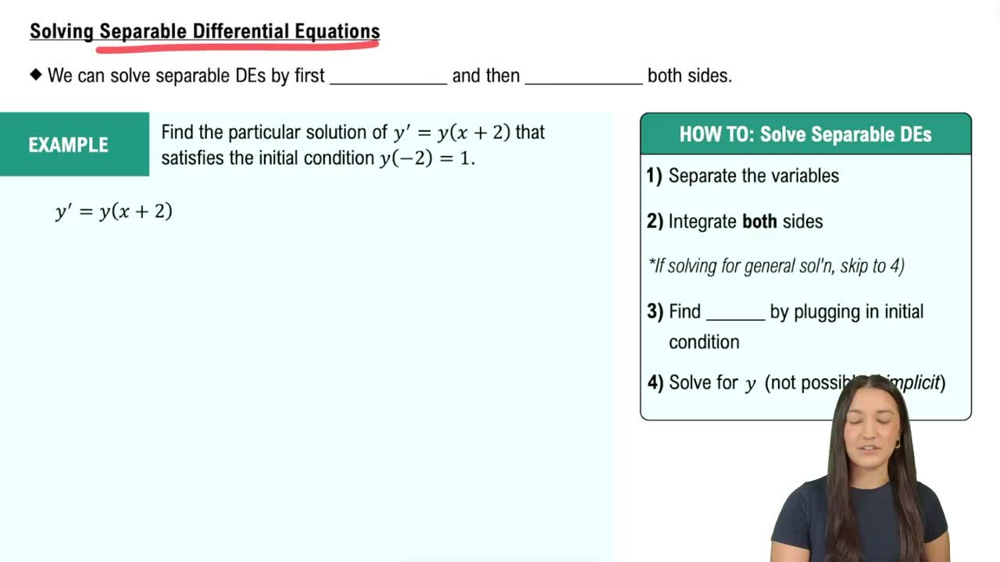
A separable differential equation can be written as a product of a function of the dependent variable and a function of the independent variable. This allows the variables to be separated on opposite sides of the equation, enabling integration with respect to each variable independently.
Integrating exponential functions involves recognizing the form e^(ax + b) and applying the rule ∫e^(ax + b) dx = (1/a)e^(ax + b) + C. This is essential when solving differential equations where the right-hand side contains exponential expressions.
After integrating, the solution often involves an implicit relation between variables. Expressing the solution explicitly means solving for the dependent variable as a function of the independent variable, which may require algebraic manipulation or applying inverse functions.

 1:57 minutes
 Verified step by step guidance
 06:06
06:06