21–32. Mean Value Theorem Consider the following functions on the given interval [a, b].
a. Determine whether the Mean Value Theorem applies to the following functions on the given interval [a, b].
b. If so, find the point(s) that are guaranteed to exist by the Mean Value Theorem.
ƒ(x) = 7 -x² ; [-1; 2]
Verified step by step guidance
1
Step 1: Verify the conditions of the Mean Value Theorem (MVT). The MVT states that if a function f(x) is continuous on the closed interval [a, b] and differentiable on the open interval (a, b), then there exists at least one point c in (a, b) such that f'(c) = (f(b) - f(a)) / (b - a).
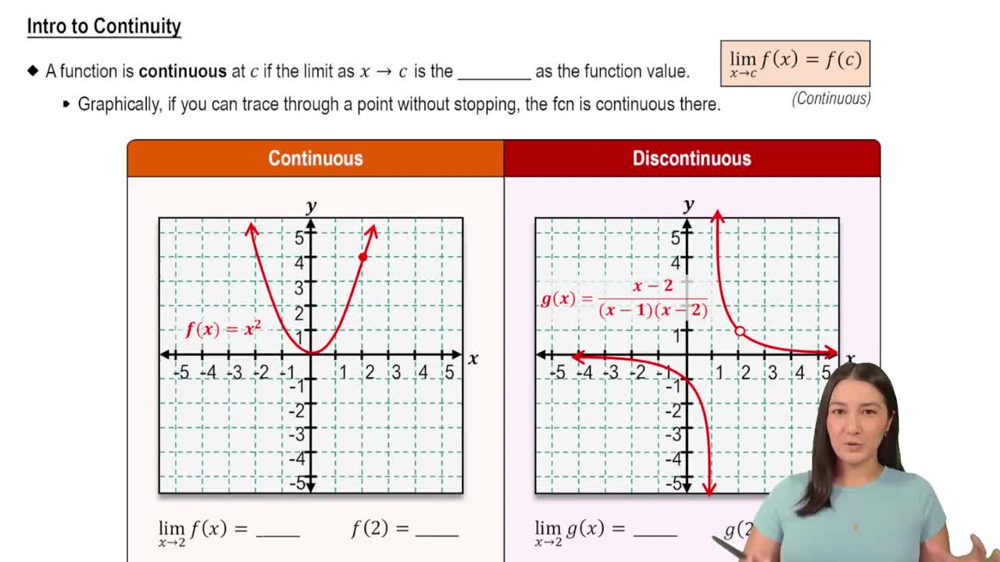
Step 2: Check continuity of f(x) = 7 - x² on the interval [-1, 2]. Since f(x) is a polynomial, it is continuous everywhere, including on the interval [-1, 2].
Step 3: Check differentiability of f(x) = 7 - x² on the interval (-1, 2). Again, since f(x) is a polynomial, it is differentiable everywhere, including on the interval (-1, 2).
Step 4: Calculate the derivative f'(x). For f(x) = 7 - x², the derivative is f'(x) = -2x.
Step 5: Use the MVT formula to find the point c. Calculate f(b) and f(a): f(2) = 7 - 2² = 3 and f(-1) = 7 - (-1)² = 6. Then, compute (f(b) - f(a)) / (b - a) = (3 - 6) / (2 - (-1)) = -1. Set f'(c) = -2c equal to -1 and solve for c.
Verified video answer for a similar problem:
This video solution was recommended by our tutors as helpful for the problem above
Video duration:
4m
Play a video:
Was this helpful?
Key Concepts
Here are the essential concepts you must grasp in order to answer the question correctly.
Mean Value Theorem (MVT)
The Mean Value Theorem states that if a function is continuous on a closed interval [a, b] and differentiable on the open interval (a, b), then there exists at least one point c in (a, b) such that the derivative at that point equals the average rate of change of the function over the interval. This theorem is fundamental in connecting the behavior of a function to its derivative.
For the Mean Value Theorem to apply, the function must be continuous on the closed interval [a, b] and differentiable on the open interval (a, b). Continuity ensures that there are no breaks or jumps in the function, while differentiability means that the function has a defined slope at every point in the interval, allowing for the application of the theorem.
Once it is established that the Mean Value Theorem applies, the next step is to find the point c where the instantaneous rate of change (the derivative) equals the average rate of change over the interval. This involves calculating the derivative of the function and setting it equal to the average rate of change, which is determined by the formula (f(b) - f(a)) / (b - a).