82-88. Improper integrals Evaluate the following integrals or show that the integral diverges. 82. ∫ (from -∞ to -1) dx/(x - 1)⁴
Verified step by step guidance
1
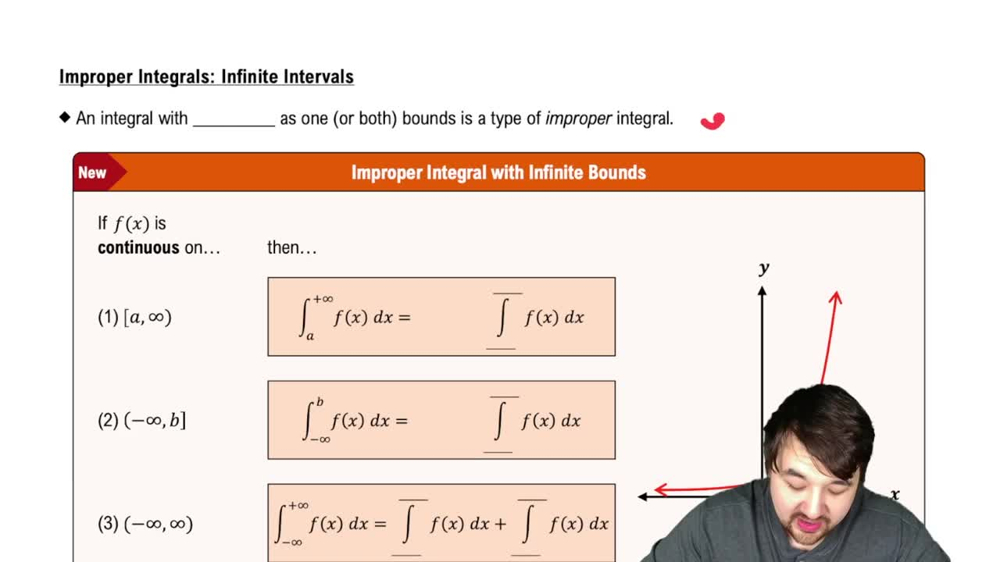
Identify the type of improper integral: Since the integral has a lower limit of -\(\infty\), this is an improper integral with an infinite limit of integration.
Rewrite the integral as a limit: Express the integral from -\(\infty\) to -1 as \( \lim_{t \to -\infty} \int_{t}^{-1} \frac{1}{(x - 1)^4} \, dx \).
Find the antiderivative: To integrate \( \frac{1}{(x - 1)^4} \), rewrite it as \( (x - 1)^{-4} \) and use the power rule for integration, which states \( \int x^n \, dx = \frac{x^{n+1}}{n+1} + C \) for \( n \neq -1 \).
Evaluate the definite integral: Substitute the antiderivative back into the limit expression and evaluate it at the bounds \( t \) and \( -1 \).
Take the limit as \( t \to -\infty \): Analyze the behavior of the antiderivative as \( t \) approaches negative infinity to determine if the integral converges or diverges.
Verified video answer for a similar problem:
This video solution was recommended by our tutors as helpful for the problem above
Video duration:
4m
Play a video:
0 Comments
Key Concepts
Here are the essential concepts you must grasp in order to answer the question correctly.
Improper Integrals
Improper integrals involve integration over an infinite interval or integrands with infinite discontinuities. To evaluate them, limits are used to approach the problematic points, determining if the integral converges to a finite value or diverges.
Rational functions like 1/(x - a)^n can have vertical asymptotes at x = a. Understanding how the function behaves near these singularities helps determine if the integral converges or diverges, especially when the exponent n affects the rate of growth or decay.
To decide if an improper integral converges, comparison tests or limit comparison tests are used by comparing the integrand to a simpler function with known integral behavior. This method helps establish convergence or divergence without explicit integration.