Defining piecewise functions Write a definition of the function whose graph is given <IMAGE>
Verified step by step guidance
1
Step 1: Identify the different segments of the graph. Look for changes in the slope, discontinuities, or any other features that indicate a new piece of the function.
Step 2: Determine the mathematical expression for each segment. This could be a linear equation, a quadratic, or another type of function, depending on the shape of the graph.
Step 3: Identify the domain for each piece of the function. This involves determining the x-values over which each segment is defined.
Step 4: Write the piecewise function using the expressions and domains identified in the previous steps. Use the format: \( f(x) = \begin{cases} \text{expression 1,} & \text{if } \text{domain 1} \\ \text{expression 2,} & \text{if } \text{domain 2} \\ \end{cases} \)
Step 5: Verify the piecewise function by checking that it matches the graph over the specified domains. Ensure continuity or note any discontinuities as needed.
Verified video answer for a similar problem:
This video solution was recommended by our tutors as helpful for the problem above
Video duration:
4m
Play a video:
Was this helpful?
Key Concepts
Here are the essential concepts you must grasp in order to answer the question correctly.
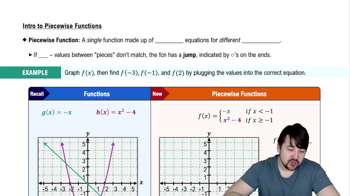
Piecewise Functions
A piecewise function is defined by multiple sub-functions, each applying to a specific interval of the function's domain. This means that the function can take different forms based on the input value. For example, a piecewise function might be defined as f(x) = x^2 for x < 0 and f(x) = 2x + 1 for x ≥ 0, illustrating how the function behaves differently in different regions.
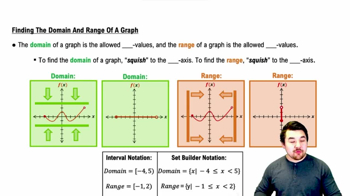
The domain of a function refers to the set of all possible input values (x-values) for which the function is defined, while the range is the set of all possible output values (y-values). Understanding the domain and range is crucial for defining piecewise functions, as each piece may have its own specific domain, affecting how the function behaves overall.
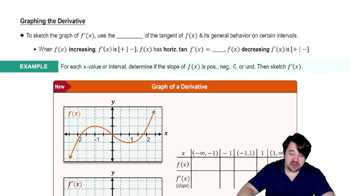
Interpreting the graph of a function involves analyzing its shape, slopes, and intercepts to understand its behavior. For piecewise functions, the graph may consist of distinct segments, each corresponding to different rules. Recognizing where these segments start and end is essential for accurately defining the function and understanding its continuity and discontinuities.