
Why is the disk method a special case of the general slicing method?
Verified step by step guidance
1
Understand that the general slicing method involves finding the volume of a solid by slicing it into thin cross-sectional pieces perpendicular to an axis, then summing the volumes of these slices using integration.
Recognize that each slice in the general slicing method has an area \(A(x)\) that depends on the position \(x\), and the volume is given by the integral \(V = \int_a^b A(x) \, dx\).
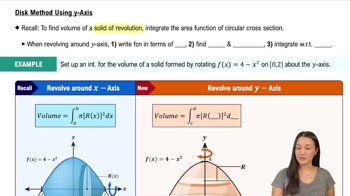
Note that the disk method is a specific case where each cross-sectional slice is a disk (a circle), so the area of each slice is \(A(x) = \pi [R(x)]^2\), where \(R(x)\) is the radius of the disk at position \(x\).
Therefore, the disk method applies the general slicing formula with the particular area function of a disk, leading to the volume formula \(V = \int_a^b \pi [R(x)]^2 \, dx\).
In summary, the disk method is a special case of the general slicing method because it uses circular cross sections, making the area function a specific formula for disks within the broader slicing framework.
Verified video answer for a similar problem:
This video solution was recommended by our tutors as helpful for the problem above
Video duration:
2m
Play a video:
0 Comments
Key Concepts
Here are the essential concepts you must grasp in order to answer the question correctly.
General Slicing Method
The general slicing method involves finding the volume of a solid by dividing it into thin cross-sectional slices perpendicular to an axis. Each slice's area is calculated, and integrating these areas over the interval gives the total volume. This method applies to solids with varying cross-sectional shapes.
The disk method is a specific application of the slicing method where each cross-section is a disk (circle). It is used when a solid is formed by revolving a region around an axis, and the radius of each disk corresponds to the distance from the axis to the function curve.
The disk method is a special case of the slicing method because it uses circular cross-sections, simplifying the area calculation to π times the radius squared. Thus, the disk method fits within the broader slicing framework by specifying the shape of the slices as disks.