Define the remainder of an infinite series.
Table of contents
- 0. Functions7h 54m
- Introduction to Functions16m
- Piecewise Functions10m
- Properties of Functions9m
- Common Functions1h 8m
- Transformations5m
- Combining Functions27m
- Exponent rules32m
- Exponential Functions28m
- Logarithmic Functions24m
- Properties of Logarithms36m
- Exponential & Logarithmic Equations35m
- Introduction to Trigonometric Functions38m
- Graphs of Trigonometric Functions44m
- Trigonometric Identities47m
- Inverse Trigonometric Functions48m
- 1. Limits and Continuity2h 2m
- 2. Intro to Derivatives1h 33m
- 3. Techniques of Differentiation3h 18m
- 4. Applications of Derivatives2h 38m
- 5. Graphical Applications of Derivatives6h 2m
- 6. Derivatives of Inverse, Exponential, & Logarithmic Functions2h 37m
- 7. Antiderivatives & Indefinite Integrals1h 26m
- 8. Definite Integrals4h 44m
- 9. Graphical Applications of Integrals2h 27m
- 10. Physics Applications of Integrals 3h 16m
- 11. Integrals of Inverse, Exponential, & Logarithmic Functions2h 34m
- 12. Techniques of Integration7h 41m
- 13. Intro to Differential Equations2h 55m
- 14. Sequences & Series5h 36m
- 15. Power Series2h 19m
- 16. Parametric Equations & Polar Coordinates7h 58m
14. Sequences & Series
Series
Problem 10.R.95b
Textbook Question
Building a tunnel — first scenario
A crew of workers is constructing a tunnel through a mountain. Understandably, the rate of construction decreases because rocks and earth must be removed a greater distance as the tunnel gets longer. Suppose each week the crew digs 0.95 of the distance it dug the previous week. In the first week, the crew constructed 100 m of tunnel.
b.What is the longest tunnel the crew can build at this rate?
Verified step by step guidance1
Recognize that the distance dug each week forms a geometric sequence where the first term \(a_1 = 100\) meters and the common ratio \(r = 0.95\) because each week the crew digs 0.95 times the previous week's distance.
Recall that the total length of the tunnel after infinitely many weeks is the sum of an infinite geometric series, which converges when \(|r| < 1\).
Use the formula for the sum of an infinite geometric series: \(S_\infty = \frac{a_1}{1 - r}\), where \(a_1\) is the first term and \(r\) is the common ratio.
Substitute the known values into the formula: \(S_\infty = \frac{100}{1 - 0.95}\) to express the total maximum length of the tunnel.
Interpret this sum as the longest tunnel the crew can build at this decreasing rate of construction.
Verified video answer for a similar problem:This video solution was recommended by our tutors as helpful for the problem above
Video duration:
1mPlay a video:
Was this helpful?
Key Concepts
Here are the essential concepts you must grasp in order to answer the question correctly.
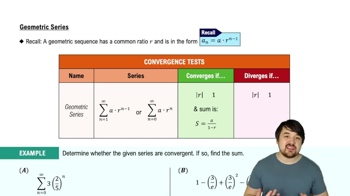
Geometric Series
A geometric series is the sum of terms where each term is a constant multiple (common ratio) of the previous one. In this problem, the weekly distances dug form a geometric sequence with ratio 0.95. Understanding how to sum an infinite geometric series helps find the total tunnel length when the digging rate decreases continuously.
Recommended video:
Geometric Series
Sum to Infinity of a Geometric Series
When the common ratio of a geometric series is between -1 and 1, the series converges to a finite sum. The formula S = a / (1 - r) calculates this sum, where 'a' is the first term and 'r' is the ratio. This concept is essential to determine the maximum tunnel length achievable as the digging rate diminishes over time.
Recommended video:
Geometric Series
Modeling Real-World Problems with Sequences
Translating a real-world scenario into a mathematical sequence allows for precise analysis. Here, the weekly digging distances decrease by a fixed percentage, forming a geometric sequence. Recognizing this pattern enables the use of sequence formulas to predict total progress and solve practical construction problems.
Recommended video:
Real World Application
Watch next
Master Intro to Series: Partial Sums with a bite sized video explanation from Patrick
Start learningRelated Videos
Related Practice
Textbook Question
19
views