Ch. 10 - Sequences and Infinite Series
Briggs - Calculus: Early Transcendentals 3rd Edition
Briggs3rd EditionCalculus: Early TranscendentalsISBN: 9780136847243Not the one you use?Change textbook
Chapter 10, Problem 10.R.95a

Building a tunnel — first scenario
A crew of workers is constructing a tunnel through a mountain. Understandably, the rate of construction decreases because rocks and earth must be removed a greater distance as the tunnel gets longer. Suppose each week the crew digs 0.95 of the distance it dug the previous week. In the first week, the crew constructed 100 m of tunnel.


a.How far does the crew dig in 10 weeks? 20 weeks? N weeks?

Verified step by step guidance
1
Identify the type of sequence described in the problem. Since each week the crew digs 0.95 times the distance dug the previous week, this is a geometric sequence where each term is multiplied by a common ratio \(r = 0.95\).
Write the general formula for the distance dug in the \(n^{th}\) week. The first term \(a_1\) is 100 meters, so the distance dug in week \(n\) is given by \(a_n = a_1 \times r^{n-1} = 100 \times 0.95^{n-1}\).
To find the total distance dug after \(N\) weeks, recognize that this is the sum of the first \(N\) terms of a geometric sequence. Use the formula for the sum of the first \(N\) terms: \(S_N = a_1 \times \frac{1 - r^N}{1 - r}\).
Apply the sum formula to calculate the total distance dug after 10 weeks by substituting \(N=10\), \(a_1=100\), and \(r=0.95\) into the formula: \(S_{10} = 100 \times \frac{1 - 0.95^{10}}{1 - 0.95}\).
Similarly, calculate the total distance dug after 20 weeks by substituting \(N=20\) into the sum formula: \(S_{20} = 100 \times \frac{1 - 0.95^{20}}{1 - 0.95}\). For a general number of weeks \(N\), use \(S_N = 100 \times \frac{1 - 0.95^{N}}{1 - 0.95}\).

Verified video answer for a similar problem:

This video solution was recommended by our tutors as helpful for the problem above.
Video duration:
2m
Was this helpful?

Key Concepts

Here are the essential concepts you must grasp in order to answer the question correctly.

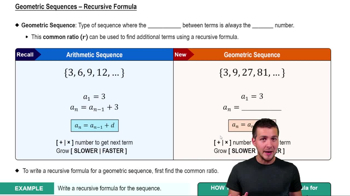
Geometric Sequences

A geometric sequence is a list of numbers where each term is found by multiplying the previous term by a constant ratio. In this problem, the distance dug each week decreases by a factor of 0.95, making it a geometric sequence with first term 100 and common ratio 0.95.
Recommended video:
Guided course
04:18
Geometric Sequences - Recursive Formula

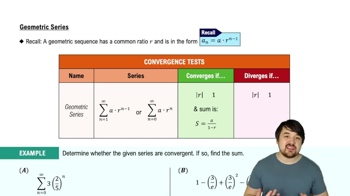
Sum of a Finite Geometric Series

The total distance dug over multiple weeks is the sum of the terms in the geometric sequence. The sum of the first n terms of a geometric series can be calculated using the formula S_n = a(1 - r^n) / (1 - r), where a is the first term and r is the common ratio.
Recommended video:
06:00
Geometric Series

Generalization to N Terms

To find the distance dug after N weeks, the formula for the sum of the first N terms of the geometric series is used. This allows calculation of the total distance for any number of weeks, not just specific values like 10 or 20.
Recommended video:
05:44
Divergence Test (nth Term Test)