Find the Maclaurin polynomials of order , and for
Table of contents
- 0. Functions7h 54m
- Introduction to Functions16m
- Piecewise Functions10m
- Properties of Functions9m
- Common Functions1h 8m
- Transformations5m
- Combining Functions27m
- Exponent rules32m
- Exponential Functions28m
- Logarithmic Functions24m
- Properties of Logarithms36m
- Exponential & Logarithmic Equations35m
- Introduction to Trigonometric Functions38m
- Graphs of Trigonometric Functions44m
- Trigonometric Identities47m
- Inverse Trigonometric Functions48m
- 1. Limits and Continuity2h 2m
- 2. Intro to Derivatives1h 33m
- 3. Techniques of Differentiation3h 18m
- 4. Applications of Derivatives2h 38m
- 5. Graphical Applications of Derivatives6h 2m
- 6. Derivatives of Inverse, Exponential, & Logarithmic Functions2h 37m
- 7. Antiderivatives & Indefinite Integrals1h 26m
- 8. Definite Integrals4h 44m
- 9. Graphical Applications of Integrals2h 27m
- 10. Physics Applications of Integrals 3h 16m
- 11. Integrals of Inverse, Exponential, & Logarithmic Functions2h 34m
- 12. Techniques of Integration7h 41m
- 13. Intro to Differential Equations2h 55m
- 14. Sequences & Series5h 36m
- 15. Power Series2h 19m
- 16. Parametric Equations & Polar Coordinates7h 58m
15. Power Series
Taylor Series & Taylor Polynomials
Problem 11.R.4
Textbook Question
Taylor polynomials Find the nth-order Taylor polynomial for the following functions centered at the given point a.
ƒ(x) = cos⁻¹ x, n = 2, a = 1/2
Verified step by step guidance1
Identify the function and the point of expansion: here, the function is \(f(x) = \cos^{-1} x\) and the center is \(a = \frac{1}{2}\).
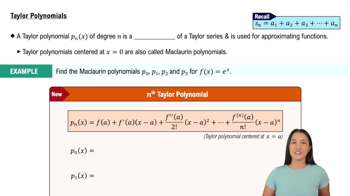
Recall the formula for the nth-order Taylor polynomial centered at \(a\):
\[T_n(x) = \sum_{k=0}^n \frac{f^{(k)}(a)}{k!} (x - a)^k,\]
where \(f^{(k)}(a)\) denotes the \(k\)th derivative of \(f\) evaluated at \(x = a\).
Calculate the function value at \(a\):
\[f(a) = \cos^{-1} \left( \frac{1}{2} \right).\]
Find the first and second derivatives of \(f(x)\):
- First derivative:
\[f'(x) = \frac{d}{dx} \cos^{-1} x = -\frac{1}{\sqrt{1 - x^2}},\]
- Second derivative:
\[f''(x) = \frac{d}{dx} f'(x) = \frac{x}{(1 - x^2)^{3/2}}.\]
Evaluate the first and second derivatives at \(x = a = \frac{1}{2}\):
\[f'(a) = -\frac{1}{\sqrt{1 - (\frac{1}{2})^2}}, \quad f''(a) = \frac{\frac{1}{2}}{(1 - (\frac{1}{2})^2)^{3/2}}.\]
Then, substitute these values into the Taylor polynomial formula up to order 2:
\[T_2(x) = f(a) + f'(a)(x - a) + \frac{f''(a)}{2}(x - a)^2.\]
Verified video answer for a similar problem:This video solution was recommended by our tutors as helpful for the problem above
Video duration:
4mPlay a video:
Was this helpful?
Key Concepts
Here are the essential concepts you must grasp in order to answer the question correctly.
Taylor Polynomials
A Taylor polynomial approximates a function near a point a by using the function's derivatives at that point. The nth-order Taylor polynomial includes terms up to the nth derivative, providing a polynomial that closely matches the function's behavior near a.
Recommended video:
Taylor Polynomials
Derivatives of Inverse Trigonometric Functions
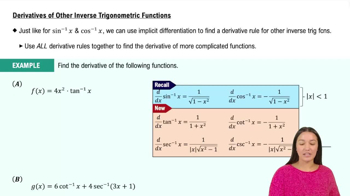
To find the Taylor polynomial of ƒ(x) = cos⁻¹(x), it is essential to know the derivatives of the inverse cosine function. These derivatives involve expressions with square roots and powers, which are used to compute the coefficients of the polynomial.
Recommended video:
Derivatives of Other Inverse Trigonometric Functions
Centering the Polynomial at a Specific Point
Centering the Taylor polynomial at a = 1/2 means all derivatives are evaluated at x = 1/2. This shifts the polynomial's approximation to be most accurate near this point, affecting the polynomial's terms and their values.
Recommended video:
Taylor Polynomials
Related Videos
Related Practice