
Find the Taylor polynomials of order , and for centered at .
Table of contents
- 0. Functions7h 54m
- Introduction to Functions16m
- Piecewise Functions10m
- Properties of Functions9m
- Common Functions1h 8m
- Transformations5m
- Combining Functions27m
- Exponent rules32m
- Exponential Functions28m
- Logarithmic Functions24m
- Properties of Logarithms36m
- Exponential & Logarithmic Equations35m
- Introduction to Trigonometric Functions38m
- Graphs of Trigonometric Functions44m
- Trigonometric Identities47m
- Inverse Trigonometric Functions48m
- 1. Limits and Continuity2h 2m
- 2. Intro to Derivatives1h 33m
- 3. Techniques of Differentiation3h 18m
- 4. Applications of Derivatives2h 38m
- 5. Graphical Applications of Derivatives6h 2m
- 6. Derivatives of Inverse, Exponential, & Logarithmic Functions2h 37m
- 7. Antiderivatives & Indefinite Integrals1h 26m
- 8. Definite Integrals4h 44m
- 9. Graphical Applications of Integrals2h 27m
- 10. Physics Applications of Integrals 3h 16m
- 11. Integrals of Inverse, Exponential, & Logarithmic Functions2h 34m
- 12. Techniques of Integration7h 41m
- 13. Intro to Differential Equations2h 55m
- 14. Sequences & Series5h 36m
- 15. Power Series2h 19m
- 16. Parametric Equations & Polar Coordinates7h 58m
15. Power Series
Taylor Series & Taylor Polynomials
Problem 11.4.22
Textbook Question
Limits Evaluate the following limits using Taylor series.
lim ₓ→∞ x(e¹/ˣ − 1)
Verified step by step guidance1
Recognize that the limit involves the expression \(x \left(e^{1/x} - 1\right)\) as \(x\) approaches infinity, which suggests using the Taylor series expansion of the exponential function around 0.
Recall the Taylor series expansion for \(e^t\) around \(t=0\):
\[e^t = 1 + t + \frac{t^2}{2!} + \frac{t^3}{3!} + \cdots\]
Substitute \(t = \frac{1}{x}\) into the series to get:
\[e^{1/x} = 1 + \frac{1}{x} + \frac{1}{2x^2} + \frac{1}{6x^3} + \cdots\]
Rewrite the original expression using this expansion:
\[x \left(e^{1/x} - 1\right) = x \left(\frac{1}{x} + \frac{1}{2x^2} + \frac{1}{6x^3} + \cdots \right)\]
Simplify the expression by multiplying \(x\) inside the parentheses and then analyze the behavior of each term as \(x \to \infty\) to determine the limit.
Verified video answer for a similar problem:This video solution was recommended by our tutors as helpful for the problem above
Video duration:
3mPlay a video:
Was this helpful?
Key Concepts
Here are the essential concepts you must grasp in order to answer the question correctly.
Limits at Infinity
Limits at infinity describe the behavior of a function as the input grows without bound. Understanding how functions behave as x approaches infinity helps determine if the function approaches a finite value, infinity, or does not exist.
Recommended video:
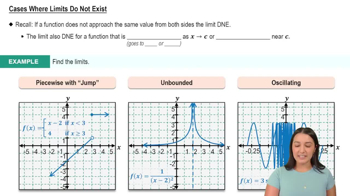
Cases Where Limits Do Not Exist
Taylor Series Expansion
A Taylor series represents a function as an infinite sum of terms calculated from its derivatives at a single point. It approximates functions near that point, allowing simplification of complex expressions, especially useful for evaluating limits.
Recommended video:
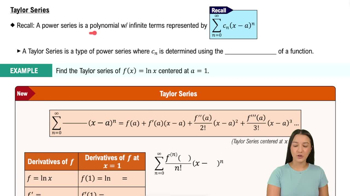
Taylor Series
Exponential Function and Its Expansion
The exponential function e^x can be expanded as a Taylor series: e^x = 1 + x + x²/2! + ... . For small values of x, this expansion helps approximate e^(1/x) and analyze the limit by substituting the series into the expression.
Recommended video:
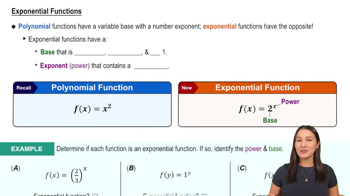
Exponential Functions
Related Videos
Related Practice
Multiple Choice
70
views
