Approximate to four decimal places using the third-degree Taylor polynomial for .
Table of contents
- 0. Functions7h 54m
- Introduction to Functions16m
- Piecewise Functions10m
- Properties of Functions9m
- Common Functions1h 8m
- Transformations5m
- Combining Functions27m
- Exponent rules32m
- Exponential Functions28m
- Logarithmic Functions24m
- Properties of Logarithms36m
- Exponential & Logarithmic Equations35m
- Introduction to Trigonometric Functions38m
- Graphs of Trigonometric Functions44m
- Trigonometric Identities47m
- Inverse Trigonometric Functions48m
- 1. Limits and Continuity2h 2m
- 2. Intro to Derivatives1h 33m
- 3. Techniques of Differentiation3h 18m
- 4. Applications of Derivatives2h 38m
- 5. Graphical Applications of Derivatives6h 2m
- 6. Derivatives of Inverse, Exponential, & Logarithmic Functions2h 37m
- 7. Antiderivatives & Indefinite Integrals1h 26m
- 8. Definite Integrals4h 44m
- 9. Graphical Applications of Integrals2h 27m
- 10. Physics Applications of Integrals 3h 16m
- 11. Integrals of Inverse, Exponential, & Logarithmic Functions2h 34m
- 12. Techniques of Integration7h 41m
- 13. Intro to Differential Equations2h 55m
- 14. Sequences & Series5h 36m
- 15. Power Series2h 19m
- 16. Parametric Equations & Polar Coordinates7h 58m
15. Power Series
Taylor Series & Taylor Polynomials
Problem 11.4.8
Textbook Question
Limits Evaluate the following limits using Taylor series.
lim ₓ→₀ (tan ⁻¹ x − x)/x³"
Verified step by step guidance1
Recognize that the problem asks to evaluate the limit \( \lim_{x \to 0} \frac{\tan^{-1} x - x}{x^3} \) using Taylor series expansions.
Recall the Taylor series expansion of \( \tan^{-1} x \) around \( x = 0 \):
\[
\tan^{-1} x = x - \frac{x^3}{3} + \frac{x^5}{5} - \cdots
\]
Substitute the Taylor series expansion into the numerator:
\[
\tan^{-1} x - x = \left(x - \frac{x^3}{3} + \cdots \right) - x = - \frac{x^3}{3} + \cdots
\]
Rewrite the original limit expression using this substitution:
\[
\lim_{x \to 0} \frac{\tan^{-1} x - x}{x^3} = \lim_{x \to 0} \frac{- \frac{x^3}{3} + \cdots}{x^3}
\]
Simplify the fraction by dividing each term by \( x^3 \), then evaluate the limit by letting \( x \to 0 \), which will eliminate higher order terms, leaving the coefficient of the leading term.
Verified video answer for a similar problem:This video solution was recommended by our tutors as helpful for the problem above
Video duration:
2mPlay a video:
Was this helpful?
Key Concepts
Here are the essential concepts you must grasp in order to answer the question correctly.
Taylor Series Expansion
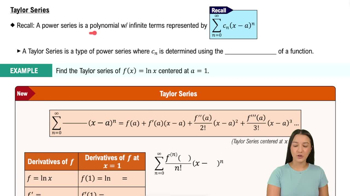
A Taylor series represents a function as an infinite sum of terms calculated from the function's derivatives at a single point. It approximates functions near that point, allowing complex expressions to be simplified into polynomials. For limits, Taylor expansions help identify dominant terms and simplify evaluation.
Recommended video:
Taylor Series
Inverse Tangent Function (arctan) Properties
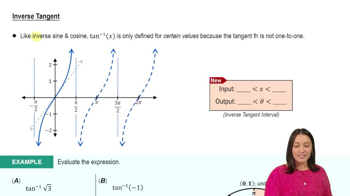
The inverse tangent function, arctan(x), is smooth and differentiable around zero, with a known Taylor series expansion. Understanding its series helps express arctan(x) as x minus higher-order terms, which is essential for evaluating limits involving arctan(x) near zero.
Recommended video:
Inverse Tangent
Limit Evaluation Using Series Expansion
When direct substitution in a limit leads to an indeterminate form, expanding functions into their Taylor series can reveal the behavior of the numerator and denominator. By comparing the lowest-order nonzero terms, one can compute the limit accurately without complex algebraic manipulation.
Recommended video:
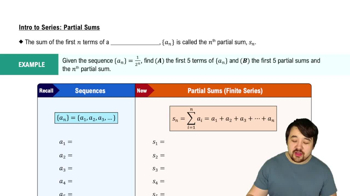
Intro to Series: Partial Sums
Related Videos
Related Practice