2–74. Integration techniques Use the methods introduced in Sections 8.1 through 8.5 to evaluate the following integrals. 65. ∫ (from 0 to 1) dy/((y + 1)(y² + 1))
Verified step by step guidance
1
Identify the integral to be solved: \(\int_0^1 \frac{dy}{(y + 1)(y^2 + 1)}\).
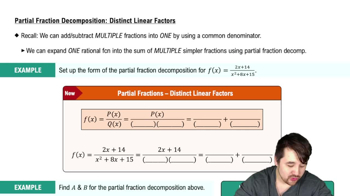
Use the method of partial fraction decomposition to express the integrand as a sum of simpler rational functions. Set up the equation: \(\frac{1}{(y + 1)(y^2 + 1)} = \frac{A}{y + 1} + \frac{By + C}{y^2 + 1}\), where \(A\), \(B\), and \(C\) are constants to be determined.
Multiply both sides of the equation by the denominator \((y + 1)(y^2 + 1)\) to clear the fractions, resulting in: \$1 = A(y^2 + 1) + (By + C)(y + 1)$.
Expand the right-hand side and collect like terms in powers of \(y\). Then, equate the coefficients of corresponding powers of \(y\) on both sides to form a system of equations for \(A\), \(B\), and \(C\).
Solve the system of equations to find the values of \(A\), \(B\), and \(C\). Substitute these back into the partial fractions, then integrate each term separately over the interval from 0 to 1.
Verified video answer for a similar problem:
This video solution was recommended by our tutors as helpful for the problem above
Video duration:
11m
Play a video:
0 Comments
Key Concepts
Here are the essential concepts you must grasp in order to answer the question correctly.
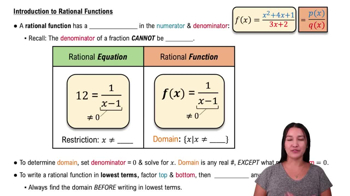
Partial Fraction Decomposition
Partial fraction decomposition is a technique used to break down a complex rational function into simpler fractions that are easier to integrate. It involves expressing the integrand as a sum of simpler rational expressions, typically linear or quadratic denominators, which can then be integrated individually.
Partial Fraction Decomposition: Distinct Linear Factors
Integration of Rational Functions
Integrating rational functions often requires algebraic manipulation such as partial fractions. Once decomposed, each term can be integrated using standard formulas, including logarithmic integrals for linear denominators and arctangent integrals for quadratic denominators without real roots.
Definite integration involves evaluating the integral between specified limits, here from 0 to 1. After finding the antiderivative, the Fundamental Theorem of Calculus is applied by substituting the upper and lower limits to compute the exact value of the integral.

 11:52 minutes
 Verified step by step guidance
 10:07
10:07