
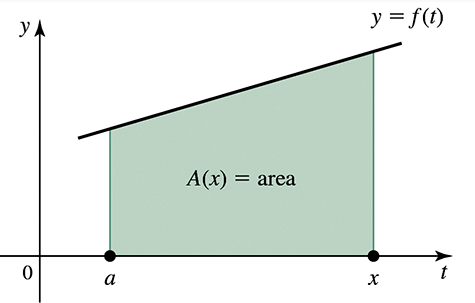
Area functions for linear functions Consider the following functions Ζ and real numbers a (see figure).
b) Verify that A'(π) = Ζ(π).
Ζ(t) = 4t + 2 , a = 0
Verified step by step guidance
1
Step 1: Understand the problem. The goal is to verify that the derivative of the area function A(x), which represents the area under the curve of f(t) = 4t + 2 from a = 0 to x, is equal to the function f(x). This involves using the Fundamental Theorem of Calculus.
Step 2: Define the area function A(x). The area function A(x) is given by the definite integral of f(t) from a = 0 to x. Mathematically, this is expressed as:
Step 3: Apply the Fundamental Theorem of Calculus. According to the theorem, if A(x) is defined as the integral of f(t) from a constant to x, then the derivative of A(x) with respect to x is equal to f(x). Mathematically, this is expressed as:
Step 4: Substitute the given function f(t) = 4t + 2 into the Fundamental Theorem of Calculus. This means that the derivative of A(x) should equal f(x), which is 4x + 2.
Step 5: Conclude the verification. By the Fundamental Theorem of Calculus, the derivative of the area function A(x) is indeed equal to f(x). Therefore, A'(x) = f(x) = 4x + 2, verifying the statement.
Verified video answer for a similar problem:
This video solution was recommended by our tutors as helpful for the problem above
Video duration:
2m
Play a video:
0 Comments
Key Concepts
Here are the essential concepts you must grasp in order to answer the question correctly.
Area Function
An area function, denoted as A(x), represents the accumulated area under a curve from a starting point 'a' to a variable endpoint 'x'. In this context, it quantifies the area between the x-axis and the function f(t) = 4t + 2 over the interval [a, x]. Understanding this concept is crucial for analyzing how the area changes as 'x' varies.
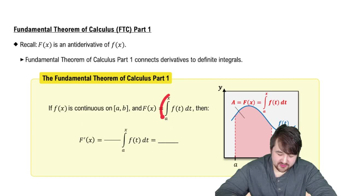
The Fundamental Theorem of Calculus establishes a connection between differentiation and integration. It states that if A(x) is the area function defined as the integral of f(t) from a to x, then the derivative A'(x) equals f(x). This theorem is essential for verifying the relationship A'(x) = f(x) in the given problem.
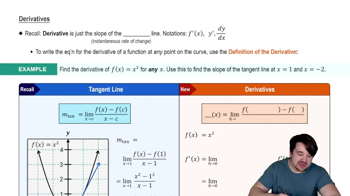
A derivative measures how a function changes as its input changes, representing the slope of the tangent line to the function at a given point. In this case, A'(x) indicates the rate of change of the area function A(x) with respect to x. Understanding derivatives is key to verifying that A'(x) equals the function f(x) in the context of the problem.