
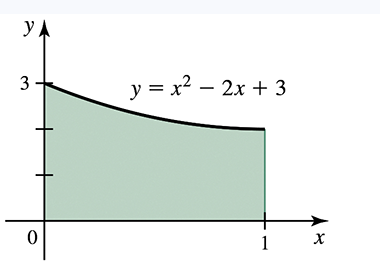



Definite integrals Evaluate the following integrals using the Fundamental Theorem of Calculus. Explain why your result is consistent with the figure.
β«βΒΉ (πΒ² β 2π + 3) dπ
Verified step by step guidance
1
Step 1: Recognize that the problem involves evaluating the definite integral β«βΒΉ (πΒ² - 2π + 3) dπ using the Fundamental Theorem of Calculus. The integral represents the area under the curve y = πΒ² - 2π + 3 from x = 0 to x = 1.
Step 2: Find the antiderivative of the integrand (πΒ² - 2π + 3). The antiderivative is calculated term by term: β«πΒ² dπ = (πΒ³/3), β«(-2π) dπ = -πΒ², and β«3 dπ = 3π. Combine these to get the antiderivative F(π) = (πΒ³/3) - πΒ² + 3π.
Step 3: Apply the Fundamental Theorem of Calculus, which states that the definite integral β«βα΅ f(π) dπ = F(b) - F(a), where F(π) is the antiderivative of f(π). Here, evaluate F(1) and F(0).
Step 4: Substitute x = 1 into the antiderivative F(π) to find F(1). Then substitute x = 0 into F(π) to find F(0). Compute the difference F(1) - F(0) to determine the value of the definite integral.
Step 5: Verify that the result is consistent with the figure. The graph shows the curve y = πΒ² - 2π + 3, and the shaded region represents the area under the curve from x = 0 to x = 1. The definite integral calculates this exact area, confirming the consistency between the result and the figure.
Verified video answer for a similar problem:
This video solution was recommended by our tutors as helpful for the problem above
Video duration:
3m
Play a video:
0 Comments
Key Concepts
Here are the essential concepts you must grasp in order to answer the question correctly.
Definite Integrals
A definite integral represents the signed area under a curve between two specified limits on the x-axis. It is calculated using the integral symbol and provides a numerical value that corresponds to the total accumulation of the function's values over that interval. In this case, the integral β«βΒΉ (πΒ² - 2π + 3) dπ calculates the area under the curve from x = 0 to x = 1.
The Fundamental Theorem of Calculus links the concept of differentiation with integration, stating that if a function is continuous on an interval, then the integral of its derivative over that interval equals the difference in the values of the original function at the endpoints. This theorem allows us to evaluate definite integrals by finding an antiderivative of the integrand and applying the limits of integration.
The graphical interpretation of integrals involves visualizing the area under a curve as the integral's value. In the provided figure, the shaded region represents the area under the curve of the function y = xΒ² - 2x + 3 from x = 0 to x = 1. This area corresponds to the result of the definite integral, illustrating how the integral quantifies the accumulation of the function's values over the specified interval.