Evaluating integrals Evaluate the following integrals.
∫₀^²π cos² 𝓍/6 d𝓍
Verified step by step guidance
1
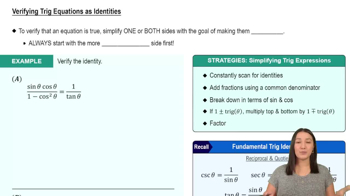
Step 1: Recognize that the integral involves a trigonometric function squared, cos²(𝓍/6). To simplify this, use the trigonometric identity: cos²(θ) = (1 + cos(2θ))/2. Rewrite the integrand using this identity: cos²(𝓍/6) = (1 + cos(2(𝓍/6)))/2.
Step 2: Substitute the simplified expression into the integral: ∫₀²π cos²(𝓍/6) d𝓍 = ∫₀²π (1/2 + (1/2)cos(𝓍/3)) d𝓍.
Step 3: Break the integral into two separate integrals for easier computation: ∫₀²π (1/2) d𝓍 + ∫₀²π (1/2)cos(𝓍/3) d𝓍.
Step 4: Evaluate the first integral, ∫₀²π (1/2) d𝓍, which is straightforward as it involves a constant. For the second integral, ∫₀²π (1/2)cos(𝓍/3) d𝓍, recognize that it requires substitution. Let u = 𝓍/3, then du = (1/3)d𝓍. Adjust the limits of integration accordingly.
Step 5: Solve each integral separately. For the first integral, compute the area under the constant function. For the second integral, after substitution, evaluate ∫cos(u) du, which is a standard integral resulting in sin(u). Substitute back to the original variable and apply the limits of integration to find the result.
Verified video answer for a similar problem:
This video solution was recommended by our tutors as helpful for the problem above
Video duration:
5m
Play a video:
0 Comments
Key Concepts
Here are the essential concepts you must grasp in order to answer the question correctly.
Definite Integrals
A definite integral calculates the accumulation of a quantity, represented as the area under a curve, between two specified limits. In this case, the integral ∫₀^²π indicates that we are finding the area under the curve of the function cos²(𝓍/6) from 0 to 2π. Understanding the properties of definite integrals, such as the Fundamental Theorem of Calculus, is essential for evaluating them.
Trigonometric identities are equations involving trigonometric functions that hold true for all values of the variables. For evaluating integrals involving trigonometric functions, such as cos²(𝓍/6), it is often useful to apply identities like the power-reduction identity: cos²(θ) = (1 + cos(2θ))/2. This simplification can make the integration process more manageable.
Integration techniques are methods used to find the integral of a function. Common techniques include substitution, integration by parts, and recognizing standard forms. For the integral ∫ cos²(𝓍/6) d𝓍, applying the power-reduction identity simplifies the function, allowing for straightforward integration, which is crucial for arriving at the correct solution.