The composite function ƒ(g(𝓍)) consists of an inner function g and an outer function ƒ. If an integrand includes ƒ(g(𝓍)), which function is often a likely choice for a new variable u?
Table of contents
- 0. Functions7h 54m
- Introduction to Functions16m
- Piecewise Functions10m
- Properties of Functions9m
- Common Functions1h 8m
- Transformations5m
- Combining Functions27m
- Exponent rules32m
- Exponential Functions28m
- Logarithmic Functions24m
- Properties of Logarithms36m
- Exponential & Logarithmic Equations35m
- Introduction to Trigonometric Functions38m
- Graphs of Trigonometric Functions44m
- Trigonometric Identities47m
- Inverse Trigonometric Functions48m
- 1. Limits and Continuity2h 2m
- 2. Intro to Derivatives1h 33m
- 3. Techniques of Differentiation3h 18m
- 4. Applications of Derivatives2h 38m
- 5. Graphical Applications of Derivatives6h 2m
- 6. Derivatives of Inverse, Exponential, & Logarithmic Functions2h 37m
- 7. Antiderivatives & Indefinite Integrals1h 26m
- 8. Definite Integrals4h 44m
- 9. Graphical Applications of Integrals2h 27m
- 10. Physics Applications of Integrals 3h 16m
- 11. Integrals of Inverse, Exponential, & Logarithmic Functions2h 34m
- 12. Techniques of Integration7h 41m
- 13. Intro to Differential Equations2h 55m
- 14. Sequences & Series5h 36m
- 15. Power Series2h 19m
- 16. Parametric Equations & Polar Coordinates7h 58m
8. Definite Integrals
Substitution
Problem 7.1.54
Textbook Question
29–62. Integrals Evaluate the following integrals. Include absolute values only when needed.
∫₀^{π} 2^{sin x} · cos x dx
Verified step by step guidance1
Recognize that the integral is of the form \(\int_0^{\pi} 2^{\sin x} \cdot \cos x \, dx\), where the integrand involves an exponential function with a trigonometric exponent multiplied by \(\cos x\).
Use substitution to simplify the integral. Let \(u = \sin x\). Then, compute the differential \(du = \cos x \, dx\).
Rewrite the integral in terms of \(u\): since \(du = \cos x \, dx\), the integral becomes \(\int_{u=\sin 0}^{u=\sin \pi} 2^u \, du\).
Evaluate the new limits of integration: \(\sin 0 = 0\) and \(\sin \pi = 0\), so the integral becomes \(\int_0^0 2^u \, du\).
Notice that the limits of integration are the same, which implies the value of the integral is zero without further calculation.
Verified video answer for a similar problem:This video solution was recommended by our tutors as helpful for the problem above
Video duration:
3mPlay a video:
Was this helpful?
Key Concepts
Here are the essential concepts you must grasp in order to answer the question correctly.
Definite Integrals
A definite integral calculates the net area under a curve between two limits, here from 0 to π. It involves evaluating the integral of a function over a specified interval, resulting in a numerical value that represents accumulation or total change.
Recommended video:
Definition of the Definite Integral
Integration by Substitution
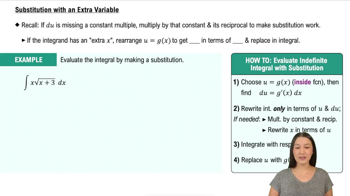
Integration by substitution simplifies integrals by changing variables to transform the integral into a more manageable form. It is especially useful when the integrand contains a function and its derivative, allowing easier evaluation.
Recommended video:
Substitution With an Extra Variable
Properties of Exponential Functions with Variable Exponents
Functions like 2^(sin x) involve an exponential with a variable exponent. Understanding how to handle such expressions, especially when combined with trigonometric functions, is key to setting up substitutions and simplifying the integral.
Recommended video:
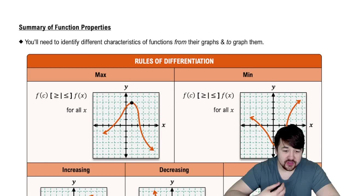
Properties of Functions
Watch next
Master Indefinite Integrals with a bite sized video explanation from Patrick
Start learningRelated Videos
Related Practice
Textbook Question
10
views