Ch. 4 - Applications of Derivatives
Hass - Thomas' Calculus 15th Edition
Hass15th EditionThomas' CalculusISBN: 9780137616077Not the one you use?Change textbook
Chapter 4, Problem 37

Graphs and Graphing


Graph the curves in Exercises 33–42.


y = 𝓍³ (8―𝓍 )

Verified step by step guidance
1
Identify the function to be graphed: \( y = x^3 (8 - x) \). This is a polynomial function, which can be expanded to \( y = 8x^3 - x^4 \).
Determine the critical points by finding the derivative of the function and setting it equal to zero. The derivative is \( y' = \frac{d}{dx}(8x^3 - x^4) = 24x^2 - 4x^3 \). Set \( 24x^2 - 4x^3 = 0 \) and solve for \( x \).
Factor the derivative: \( 4x^2(6 - x) = 0 \). This gives the critical points \( x = 0 \) and \( x = 6 \).
Evaluate the function at the critical points and endpoints to determine the behavior of the graph. Calculate \( y(0) \), \( y(6) \), and consider the behavior as \( x \to \pm \infty \).
Analyze the intervals determined by the critical points to understand where the function is increasing or decreasing. Use the first derivative test on intervals \((-\infty, 0)\), \((0, 6)\), and \((6, \infty)\) to determine the nature of each critical point (local maxima, minima, or saddle point).

Verified video answer for a similar problem:

This video solution was recommended by our tutors as helpful for the problem above.
Video duration:
10m
Was this helpful?

Key Concepts

Here are the essential concepts you must grasp in order to answer the question correctly.

Polynomial Functions

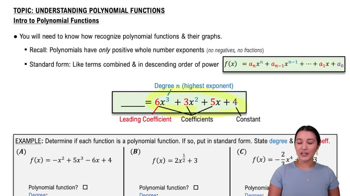
A polynomial function is an expression consisting of variables and coefficients, involving only the operations of addition, subtraction, multiplication, and non-negative integer exponents. The given function y = x³(8−x) is a polynomial of degree 4, which can be expanded to y = 8x³ − x⁴. Understanding the behavior of polynomial functions, such as end behavior and turning points, is crucial for graphing them.
Recommended video:
6:04
Introduction to Polynomial Functions

Factoring and Roots

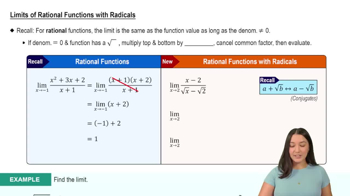
Factoring involves expressing a polynomial as a product of its factors, which can help identify the roots or zeros of the function. For y = x³(8−x), the roots are x = 0 and x = 8, where the graph intersects the x-axis. These roots are essential for sketching the graph, as they indicate where the function changes sign and crosses the axis.
Recommended video:
06:13
Limits of Rational Functions with Radicals

Graphing Techniques

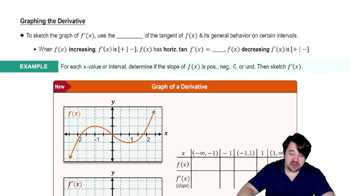
Graphing techniques involve plotting key points, such as intercepts and turning points, and understanding the shape and symmetry of the graph. For y = x³(8−x), one should consider the roots, the behavior as x approaches infinity, and any symmetry. The function is symmetric about the y-axis, and its end behavior is determined by the highest degree term, −x⁴, indicating the graph falls to negative infinity as x approaches positive or negative infinity.
Recommended video:
06:15
Graphing The Derivative