
Sketch the graphs of the rational functions in Exercises 53–60. y = (x2 + 1) / x
Verified step by step guidance
1
Identify the rational function: \( y = \frac{x^2 + 1}{x} \). This function is a rational function because it is the ratio of two polynomials.
Determine the domain of the function. The denominator \( x \) cannot be zero, so the domain is all real numbers except \( x = 0 \).
Find the vertical asymptote by setting the denominator equal to zero. Since \( x = 0 \) makes the denominator zero, there is a vertical asymptote at \( x = 0 \).
Simplify the function if possible. Here, \( y = \frac{x^2 + 1}{x} = x + \frac{1}{x} \). This helps in understanding the behavior of the function as \( x \to \infty \) and \( x \to -\infty \).
Analyze the behavior of the function as \( x \to \infty \) and \( x \to -\infty \). As \( x \to \infty \), \( y \approx x \), and as \( x \to -\infty \), \( y \approx x \). This suggests that the graph will resemble the line \( y = x \) for large values of \( |x| \).
Verified video answer for a similar problem:
This video solution was recommended by our tutors as helpful for the problem above
Video duration:
10m
Play a video:
Was this helpful?
Key Concepts
Here are the essential concepts you must grasp in order to answer the question correctly.
Rational Functions
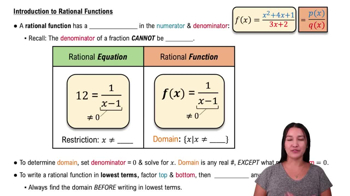
A rational function is a ratio of two polynomials, where the numerator and denominator are polynomial expressions. Understanding the behavior of rational functions involves analyzing their asymptotes, intercepts, and overall shape. In this case, the function y = (x^2 + 1) / x is a rational function with a polynomial numerator and a linear denominator.
Vertical asymptotes occur in rational functions where the denominator equals zero, causing the function to approach infinity. For y = (x^2 + 1) / x, the vertical asymptote is at x = 0, since the denominator becomes zero at this point. This asymptote divides the graph into separate regions, influencing the function's behavior near x = 0.
End behavior describes how a function behaves as x approaches positive or negative infinity. For rational functions, this is often determined by the degrees of the numerator and denominator. In y = (x^2 + 1) / x, as x approaches infinity, the function behaves like y = x, since the highest degree term in the numerator dominates, indicating a linear growth.