
Ch. 11 - Power Series
Briggs - Calculus: Early Transcendentals 3rd Edition
Briggs3rd EditionCalculus: Early TranscendentalsISBN: 9780136847243Not the one you use?Change textbook
Chapter 11, Problem 11.4.78a

Sine integral function The function Si(x) = ∫₀ˣ f(t) dt, where f(t) = {(sin t)/t if t ≠ 0, 1 if t = 0, is called the sine integral function.
a. Expand the integrand in a Taylor series centered at 0.

Verified step by step guidance
1
Recall the definition of the sine integral function: \(\mathrm{Si}(x) = \int_0^x f(t) \, dt\), where \(f(t) = \frac{\sin t}{t}\) for \(t \neq 0\) and \(f(0) = 1\).
To find the Taylor series expansion of the integrand \(f(t)\) centered at 0, start with the Taylor series expansion of \(\sin t\) around 0: \(\sin t = \sum_{n=0}^\infty (-1)^n \frac{t^{2n+1}}{(2n+1)!}\).
Divide the series for \(\sin t\) by \(t\) to get the series for \(f(t) = \frac{\sin t}{t}\): \(f(t) = \sum_{n=0}^\infty (-1)^n \frac{t^{2n}}{(2n+1)!}\).
Note that this series is valid for all \(t\) including \(t=0\) because the term for \(n=0\) is \(\frac{t^0}{1!} = 1\), which matches the given \(f(0) = 1\).
Thus, the Taylor series expansion of the integrand \(f(t)\) centered at 0 is \(f(t) = 1 - \frac{t^2}{3!} + \frac{t^4}{5!} - \frac{t^6}{7!} + \cdots\).

Verified video answer for a similar problem:

This video solution was recommended by our tutors as helpful for the problem above.
Video duration:
1m
Was this helpful?

Key Concepts

Here are the essential concepts you must grasp in order to answer the question correctly.

Sine Integral Function

The sine integral function Si(x) is defined as the integral from 0 to x of (sin t)/t dt, with a special value at t = 0 to ensure continuity. It is important to understand this function as an example of an integral involving a non-elementary integrand that requires special handling at singular points.
Recommended video:
5:53
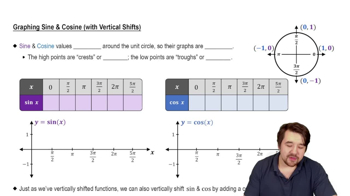
Graph of Sine and Cosine Function

Taylor Series Expansion

A Taylor series represents a function as an infinite sum of terms calculated from the derivatives at a single point, usually zero. Expanding the integrand (sin t)/t in a Taylor series centered at 0 involves expressing sin t as its power series and dividing by t, carefully handling the limit at t = 0.
Recommended video:
08:42
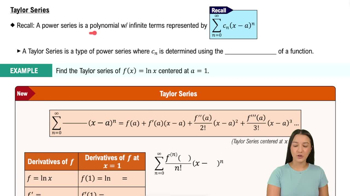
Taylor Series

Handling Indeterminate Forms and Continuity

Since (sin t)/t is undefined at t = 0, understanding limits and continuity is essential. Using the limit lim_{t→0} (sin t)/t = 1 ensures the function is well-defined and continuous at zero, which is crucial for correctly expanding the integrand in a Taylor series.
Recommended video:
05:34
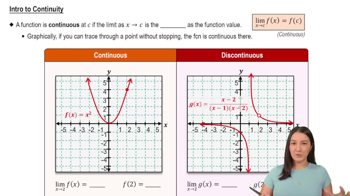
Intro to Continuity