
In terms of the remainder, what does it mean for a Taylor series for a function f to converge to f?
Table of contents
- 0. Functions7h 54m
- Introduction to Functions16m
- Piecewise Functions10m
- Properties of Functions9m
- Common Functions1h 8m
- Transformations5m
- Combining Functions27m
- Exponent rules32m
- Exponential Functions28m
- Logarithmic Functions24m
- Properties of Logarithms36m
- Exponential & Logarithmic Equations35m
- Introduction to Trigonometric Functions38m
- Graphs of Trigonometric Functions44m
- Trigonometric Identities47m
- Inverse Trigonometric Functions48m
- 1. Limits and Continuity2h 2m
- 2. Intro to Derivatives1h 33m
- 3. Techniques of Differentiation3h 18m
- 4. Applications of Derivatives2h 38m
- 5. Graphical Applications of Derivatives6h 2m
- 6. Derivatives of Inverse, Exponential, & Logarithmic Functions2h 37m
- 7. Antiderivatives & Indefinite Integrals1h 26m
- 8. Definite Integrals4h 44m
- 9. Graphical Applications of Integrals2h 27m
- 10. Physics Applications of Integrals 3h 16m
- 11. Integrals of Inverse, Exponential, & Logarithmic Functions2h 34m
- 12. Techniques of Integration7h 41m
- 13. Intro to Differential Equations2h 55m
- 14. Sequences & Series5h 36m
- 15. Power Series2h 19m
- 16. Parametric Equations & Polar Coordinates7h 58m
15. Power Series
Taylor Series & Taylor Polynomials
Problem 11.4.27
Textbook Question
Power series for derivatives
a. Differentiate the Taylor series centered at 0 for the following functions.
b. Identify the function represented by the differentiated series.
c. Give the interval of convergence of the power series for the derivative.
f(x) = ln (1 + x)
Verified step by step guidance1
Start with the Taylor series expansion of the function \(f(x) = \ln(1 + x)\) centered at 0. Recall that the Taylor series for \(\ln(1 + x)\) is given by the alternating series \(\sum_{n=1}^{\infty} (-1)^{n+1} \frac{x^n}{n}\) for \(|x| < 1\).
Differentiate the series term-by-term with respect to \(x\). Use the rule \(\frac{d}{dx} \left( x^n \right) = n x^{n-1}\). Applying this to each term, the differentiated series becomes \(\sum_{n=1}^{\infty} (-1)^{n+1} \frac{d}{dx} \left( \frac{x^n}{n} \right) = \sum_{n=1}^{\infty} (-1)^{n+1} x^{n-1}\).
Rewrite the differentiated series to identify the function it represents. Notice that \(\sum_{n=1}^{\infty} (-1)^{n+1} x^{n-1}\) can be re-indexed or recognized as a geometric series with alternating signs. This series corresponds to \(\frac{1}{1+x}\) for \(|x| < 1\).
Confirm the function represented by the differentiated series is indeed \(f'(x) = \frac{1}{1+x}\), which matches the derivative of \(f(x) = \ln(1+x)\).
Determine the interval of convergence for the differentiated series. Since the original series converges for \(|x| < 1\) and differentiation does not change the radius of convergence, the interval of convergence remains \((-1, 1)\). Check endpoints separately if needed.
Verified video answer for a similar problem:This video solution was recommended by our tutors as helpful for the problem above
Video duration:
5mPlay a video:
Was this helpful?
Key Concepts
Here are the essential concepts you must grasp in order to answer the question correctly.
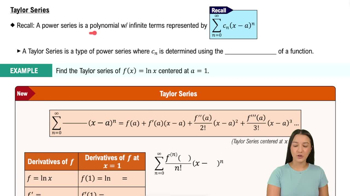
Taylor Series Expansion
A Taylor series represents a function as an infinite sum of terms calculated from the function's derivatives at a single point, often zero (Maclaurin series). It allows complex functions to be expressed as power series, facilitating differentiation and integration term-by-term.
Recommended video:
Taylor Series
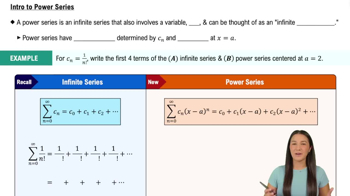
Term-by-Term Differentiation of Power Series
Power series can be differentiated term-by-term within their interval of convergence. Differentiating each term individually produces a new power series representing the derivative of the original function, preserving convergence properties inside the interval.
Recommended video:
Intro to Power Series
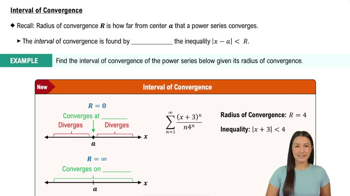
Interval of Convergence
The interval of convergence is the set of x-values for which a power series converges. Differentiating a power series does not change its radius of convergence, but the behavior at endpoints must be checked separately to determine the exact interval for the derivative series.
Recommended video:
Interval of Convergence
Related Videos
Related Practice
Textbook Question
14
views
